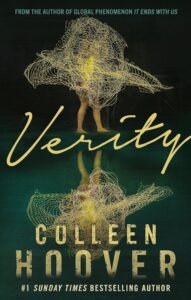
Verity
by Colleen Hoover
“A struggling writer uncovers a chilling autobiography that blurs the lines between truth and fiction, love and obsession, in a gothic tale of psychological suspense and profound moral ambiguity.”
Table of Contents
ToggleOverview
Colleen Hoover’s ‘Verity’ plunges readers into a dark, unsettling world where the boundaries of truth, sanity, and love are constantly challenged.
The narrative centres on Lowen Ashleigh, a struggling author grappling with financial difficulties and the recent death of her mother.
Her life takes an unexpected, albeit macabre, turn when she is offered a life-changing opportunity: to complete the remaining books in a highly successful series penned by the acclaimed, yet now incapacitated, author Verity Crawford.
Verity, a celebrated writer of psychological thrillers, lies in a vegetative state following a tragic car accident, leaving her husband, Jeremy Crawford, desperate to preserve her literary legacy. Lowen is invited to the isolated Crawford estate in Vermont, a setting that immediately imbues the story with a gothic, claustrophobic atmosphere. Her task is to sift through Verity’s extensive notes and outlines, attempting to mimic her distinctive voice and complete the series. However, amidst the professional endeavour, Lowen stumbles upon Verity’s unfinished autobiography, a document never intended for public consumption.
This manuscript, titled ‘So Be It’, quickly transforms from a mere biographical account into a chilling confession of Verity’s darkest thoughts and actions. It paints a portrait of a woman devoid of maternal affection, harbouring a profound disdain for her children, and detailing disturbing events surrounding the deaths of her two daughters.
As Lowen delves deeper into Verity’s psyche through her own words, she becomes increasingly entangled in the Crawford family’s tragic history, all whilst developing a forbidden attraction to the enigmatic Jeremy. The book masterfully builds tension, forcing Lowen—and the reader—to question everything: Verity’s true nature, Jeremy’s innocence, and the very fabric of reality within the isolated house. It is a relentless exploration of psychological horror, domestic suspense, and the terrifying power of narrative.
Key Takeaways
The Nature of Truth and Perception
‘Verity’ masterfully explores the elusive nature of truth, demonstrating how easily it can be manipulated, obscured, or entirely fabricated.
The entire narrative hinges on the reader’s interpretation of two conflicting accounts: Verity’s autobiography and her final letter. This forces a critical examination of how personal biases, emotional attachments, and the desire for a particular outcome can shape one’s perception of reality.
The book challenges the reader to question the reliability of any single narrative, highlighting that truth is often subjective and deeply unsettling.
Maternal Instincts and Madness
A central, disturbing theme is the subversion of traditional maternal love. Verity’s autobiography presents a chilling portrayal of a mother devoid of affection, capable of extreme cruelty towards her own children.
This narrative arc delves into the darkest aspects of the human psyche, exploring the potential for profound psychological disturbance within the context of family.
The ambiguity of the ending, however, also raises the question of whether this portrayal was a deliberate fabrication, a weaponised narrative designed to condemn or protect.
The Power of Narrative and Unreliable Narration
Colleen Hoover expertly uses the concept of narrative as both a tool for revelation and a weapon for deception. Verity’s autobiography serves as a powerful, albeit potentially false, narrative that dictates Lowen’s actions and beliefs.
The book itself becomes a meta-commentary on storytelling, where the act of writing can create realities, distort memories, and manipulate readers.
The ultimate unreliability of both Verity’s written words and Lowen’s interpretation underscores the inherent dangers and immense power of subjective storytelling.
Love, Obsession, and Deception in Relationships
The novel delves into the complex and often toxic interplay of love, obsession, and deception within intimate relationships. Jeremy’s love for Verity, Lowen’s burgeoning feelings for Jeremy, and Verity’s own twisted affections are all tainted by manipulation and hidden agendas.
The story examines how far individuals will go to protect those they love, or to secure their own desires, even if it means committing heinous acts or living with profound secrets.
It highlights how easily love can blind one to the truth, or be used as a justification for morally questionable decisions.
Chapter Breakdown
Chapter 1: The Unsettling Proposition
Lowen Ashleigh’s life is in disarray. A struggling writer, she finds herself in a precarious financial situation and is still reeling from the recent loss of her mother. A chance, and rather gruesome, encounter in New York City leads her to Jeremy Crawford, the handsome and enigmatic husband of the renowned author Verity Crawford. Verity is incapacitated, having suffered severe injuries in a car accident that has left her in a vegetative state, unable to communicate or care for herself.
Jeremy, desperate to ensure his wife’s lucrative book series is completed, offers Lowen an extraordinary opportunity: to move into their isolated Vermont estate and ghostwrite the remaining novels using Verity’s extensive notes. Despite her initial apprehension, Lowen accepts, driven by financial necessity and a burgeoning curiosity.
Upon arriving at the sprawling, somewhat dilapidated house, Lowen is immediately struck by its oppressive atmosphere and the unsettling presence of the comatose Verity, who lies in a room just down the hall, tended to by a nurse. She also meets Crew, Verity and Jeremy’s young son, the sole surviving child after the tragic deaths of his two sisters.
Lowen’s initial days are spent acclimatising to the strange environment and the heavy weight of the Crawford family’s grief. She begins to sort through Verity’s office, a space brimming with the remnants of a brilliant, yet perhaps disturbed, mind. The house itself seems to hold secrets, and Lowen feels an almost palpable sense of unease, a premonition of the darkness she is about to uncover.
Key Points
- Lowen Ashleigh, a struggling writer, is offered a lucrative ghostwriting contract by Jeremy Crawford to complete his incapacitated wife Verity’s successful book series.
- Lowen moves into the isolated Crawford estate in Vermont, where Verity lies in a vegetative state, and meets their young son, Crew.
- An immediate sense of unease and gothic atmosphere pervades the house, hinting at underlying secrets and tragedies.
Chapter 2: The Manuscript’s Shadow
As Lowen delves into Verity’s office, searching for outlines and notes for the series, she stumbles upon a hidden, unfinished manuscript titled ‘So Be It’. This is not a work of fiction, but Verity’s autobiography, a document never intended for anyone else’s eyes. Lowen’s professional curiosity quickly morphs into an obsessive need to read every word, and what she discovers is profoundly disturbing.
The autobiography paints a chilling portrait of Verity Crawford, utterly contradicting her public image as a loving wife and devoted mother. Verity confesses to a profound lack of maternal affection, admitting she never truly loved her children. She details her manipulative nature, her calculated efforts to control Jeremy, and her deep-seated resentment towards her daughters, particularly the eldest, Harper. The narrative is cold, clinical, and utterly devoid of remorse, revealing a woman capable of immense psychological cruelty.
Simultaneously, Lowen finds herself increasingly drawn to Jeremy. His kindness, his grief, and his devotion to his comatose wife create a complex emotional landscape. Their shared proximity in the isolated house, coupled with the dark secrets Lowen is uncovering, fosters a forbidden attraction that complicates her professional duties and moral compass. The unsettling feeling that Verity, despite her vegetative state, is somehow aware of their growing connection, adds another layer of psychological tension.
Key Points
- Lowen discovers Verity’s hidden, unfinished autobiography, ‘So Be It’, which reveals a disturbing, unloving side of the acclaimed author.
- The manuscript details Verity’s lack of maternal affection, her manipulative personality, and her resentment towards her daughters.
- Lowen develops a strong, forbidden attraction to Jeremy, complicating her role and intensifying the psychological tension within the house.
Chapter 3: Unveiling the Horrors
The autobiography’s revelations escalate from disturbing confessions to outright horrors. Verity’s narrative delves into the circumstances surrounding the deaths of her two daughters. She chillingly describes how she intentionally caused the drowning of her eldest daughter, Harper, driven by jealousy over Jeremy’s affection for the child and a desire to regain his undivided attention. The account is graphic and horrifying, leaving Lowen sickened and terrified.
Further chapters detail Verity’s psychological torment of her other daughter, Merritt, and her growing disdain for Crew. Lowen becomes convinced that Verity is not merely a disturbed individual, but a dangerous psychopath, and that Crew’s life could still be at risk if Verity were ever to recover. The line between Verity’s fictional thrillers and her real-life atrocities blurs, making Lowen question the nature of evil and the capacity for human cruelty.
Lowen’s fear for Crew’s safety, coupled with her deepening feelings for Jeremy, propels her towards a moral precipice. She grapples with the immense burden of the truth she holds, knowing that revealing the manuscript would shatter Jeremy’s perception of his wife and potentially destroy his family’s legacy. Strange occurrences in the house—a flickering light, a misplaced object, a fleeting shadow—further fuel Lowen’s paranoia, making her wonder if Verity is not as incapacitated as she appears, or if the house itself is haunted by the tragedies it has witnessed.
Key Points
- Verity’s autobiography reveals her intentional drowning of her daughter, Harper, driven by jealousy and a desire for Jeremy’s attention.
- Lowen becomes convinced Verity is a dangerous psychopath, fearing for Crew’s safety if Verity were to recover.
- Lowen grapples with the moral dilemma of revealing the horrifying manuscript to Jeremy, whilst experiencing unsettling phenomena in the house.
Chapter 4: The Confrontation and Confession
The weight of Verity’s autobiography becomes unbearable for Lowen. After much internal deliberation and escalating fear for Crew, she decides she must show Jeremy the manuscript. She believes he deserves to know the truth about the woman he has loved and mourned, and that it is the only way to protect his son. The revelation is, predictably, devastating for Jeremy. He is initially in disbelief, then overwhelmed by a mixture of horror, grief, and rage as he reads his wife’s chilling confessions.
The discovery culminates in a dramatic and violent confrontation. Jeremy, now convinced of Verity’s monstrous nature and her culpability in their daughters’ deaths, confronts his comatose wife. In a shocking turn of events, Verity appears to react, seemingly confirming Lowen’s deepest fears about her awareness. This leads Jeremy to take drastic action, believing he is protecting Crew and avenging his daughters. He smothers Verity, staging it to look like a natural death, an act Lowen witnesses and, in her terror and conviction, tacitly supports.
In the aftermath, Lowen and Jeremy attempt to piece together their lives, bound by the shared secret and the horrific events. They dispose of the autobiography, agreeing to bury the truth and move forward, hoping to find solace and a future together. The act of violence, though morally ambiguous, is presented as a desperate measure born from extreme circumstances and the profound psychological manipulation Verity exerted.
Key Points
- Lowen reveals Verity’s autobiography to Jeremy, who is devastated by the horrifying confessions of his wife’s true nature.
- A dramatic confrontation ensues, during which Verity appears to react, prompting Jeremy to smother her, believing he is protecting Crew and avenging his daughters.
- Lowen and Jeremy dispose of the manuscript and attempt to move on, bound by their shared secret and the violent act.
Chapter 5: The Final Twist and Lingering Ambiguity
Months pass, and Lowen and Jeremy have built a new life together, seemingly finding peace and happiness. Lowen is pregnant with their child, and they are attempting to move past the trauma of the past. However, the shadows of the Crawford estate and Verity’s legacy continue to loom. One day, whilst packing up Verity’s remaining belongings, Lowen discovers a hidden letter tucked inside a secret compartment of Verity’s favourite necklace. This letter, written by Verity, shatters Lowen’s carefully constructed reality once more.
The letter claims that the autobiography, ‘So Be It’, was not a true confession but a mere writing exercise, an exploration of a villain’s mind for a potential new book. In this final, shocking twist, Verity asserts that she was, in fact, a loving mother and wife, and that Jeremy was the truly manipulative and dangerous one. She alleges that Jeremy was responsible for the deaths of their daughters, and that he staged her accident and paralysis to control her and eventually eliminate her. She claims her ‘reaction’ during the confrontation was a desperate attempt to communicate her truth.
This revelation throws everything Lowen believed into question. Was Verity a monstrous psychopath, or a victim of a manipulative husband? Was the autobiography a confession or a clever, vengeful fabrication? The book concludes with Lowen grappling with this profound ambiguity, unable to discern the true villain or victim. The reader is left to ponder which narrative is the truth, and whether Lowen’s own perception has been irrevocably skewed by love, fear, and the power of suggestion.
Key Points
- Months after Verity’s death, Lowen discovers a hidden letter from Verity, claiming the autobiography was a fictional writing exercise.
- The letter alleges that Jeremy was the true villain, responsible for their daughters’ deaths and Verity’s accident and paralysis.
- The ending leaves the reader with profound ambiguity, questioning the true nature of Verity and Jeremy, and the reliability of all narratives presented.
Conclusion
‘Verity’ by Colleen Hoover stands as a compelling and deeply unsettling work that transcends typical romance or thriller classifications, instead carving out a niche as a potent psychological suspense novel with gothic undertones. Its impact on readers has been considerable, often polarising, yet undeniably memorable. Hoover, typically known for her emotionally charged romance novels, demonstrates a remarkable versatility in crafting a narrative steeped in dread, moral ambiguity, and relentless tension.
The book’s enduring appeal lies in its audacious plot twists and its refusal to offer a clear-cut resolution. The final, devastating revelation leaves the reader in a state of profound uncertainty, forcing them to re-evaluate every preceding event and character motivation. This narrative technique is both frustrating and exhilarating, ensuring that ‘Verity’ lingers in the mind long after the final page is turned, prompting endless debate about the ‘true’ ending.
Critically, ‘Verity’ has been lauded for its masterful pacing, its ability to build suffocating suspense, and its unflinching exploration of dark themes such as infanticide, manipulation, and the fragility of truth. Whilst some may find its graphic content and moral ambiguities challenging, it is precisely these elements that elevate it beyond a simple genre piece. It is a sophisticated examination of human depravity and the terrifying power of narrative, cementing its place as a significant contribution to contemporary psychological fiction and a testament to Hoover’s evolving literary prowess.