
The White Tiger
By Aravind Adiga
“A darkly satirical and unflinching portrait of modern India, told through the eyes of a morally ambiguous entrepreneur who rises from abject poverty through a shocking act of rebellion.”
Table of Contents
ToggleOverview
Aravind Adiga’s Booker Prize-winning novel, “The White Tiger”, presents a searing, often cynical, yet undeniably compelling narrative of India’s stark socio-economic disparities and the brutal realities of globalisation.
Told through a series of epistolary confessions from Balram Halwai, a self-proclaimed ‘entrepreneur’ and former servant, to the Chinese Premier Wen Jiabao, the novel dissects the complex interplay of caste, class, corruption, and ambition in a rapidly changing nation.
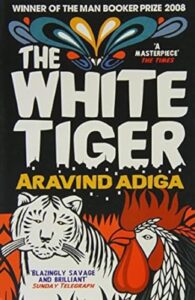
Balram’s journey from the ‘Darkness’ of rural Laxmangarh to the ‘Light’ of entrepreneurial Bangalore is not one of conventional heroism, but rather a testament to the extreme measures an individual might take to escape the ‘Rooster Coop’ – Adiga’s potent metaphor for the systemic oppression that keeps the poor subservient. His narrative voice is at once witty, philosophical, and deeply unsettling, offering a unique perspective on the moral compromises inherent in India’s economic boom.
The novel functions as a scathing critique of both the feudalistic remnants of Indian society and the superficiality of its burgeoning middle and upper classes. Adiga masterfully exposes the hypocrisy and moral decay that permeate all levels of society, from the corrupt politicians and landlords to the seemingly modern, Western-educated elite. Balram, despite his heinous crime, emerges as a complex anti-hero, a product of the very system he ultimately subverts.
“The White Tiger” is more than just a rags-to-riches story; it is a profound meditation on identity, freedom, and the elusive nature of justice in a world where opportunity is often synonymous with exploitation. Adiga’s prose is sharp, incisive, and laced with dark humour, making the novel a provocative and unforgettable exploration of the human cost of progress and the desperate lengths to which individuals will go to forge their own destiny.
Key Takeaways
The 'Rooster Coop' Metaphor and Systemic Oppression
Adiga’s central metaphor, the ‘Rooster Coop’, powerfully illustrates the psychological and societal mechanisms that trap the poor in a cycle of servitude. It’s not just physical chains but an internalised belief system that prevents rebellion, where the poor are conditioned to accept their fate, even when they outnumber their oppressors.
Balram’s breaking free from this coop, through a violent act, underscores the extreme difficulty and moral cost of escaping deeply entrenched class structures in India.
– Moral Ambiguity of Success and Justice: The novel challenges conventional notions of morality and justice. Balram’s journey to success is predicated on murder and theft, yet he presents himself as a victim of circumstance, forced into his actions by a corrupt and unjust system.
Adiga forces the reader to confront whether such a violent act can be justified as a form of liberation, questioning if true justice can exist for the downtrodden within a fundamentally corrupt society. Balram’s ‘success’ is a direct consequence of his ‘crime’, blurring the lines between villainy and heroism.
India's Dual Realities: 'Darkness' and 'Light'
Adiga vividly portrays the stark dichotomy between rural and urban India, labelling them the ‘Darkness’ and the ‘Light’. The ‘Darkness’ represents the feudal, impoverished, and corrupt villages, while the ‘Light’ symbolises the modern, globalised, and economically booming cities.
However, Balram’s narrative reveals that the ‘Light’ is not without its own shadows, as urban prosperity often rests upon exploitation, corruption, and a profound indifference to human suffering, suggesting that the ‘Darkness’ merely takes on a different guise in the cities.
Corruption as a Social Fabric
Corruption is not merely an isolated problem in ‘The White Tiger’; it is depicted as an intrinsic and pervasive element of Indian society, from the local landlords and police to the highest echelons of government and business.
Balram’s narrative normalises corruption, presenting it as the grease that makes the wheels of society turn, the only way to get things done, and a necessary tool for survival and advancement. This portrayal highlights how deeply ingrained and systemic corruption is, affecting every aspect of life and making it nearly impossible for individuals to escape its grasp without engaging in it themselves.
Chapter Breakdown
Chapter 1: From Darkness to Light: Balram’s Origins in Laxmangarh
The novel opens with Balram Halwai, now a successful entrepreneur in Bangalore, recounting his life story in a series of letters addressed to the Chinese Premier. He begins by detailing his humble, impoverished origins in the village of Laxmangarh, a place he vividly describes as the ‘Darkness’ – a stark contrast to the ‘Light’ of modern India’s cities. Born into the Halwai (sweet-maker) caste, Balram’s early life is characterised by squalor, disease, and the pervasive influence of corrupt landlords, known as ‘The Stork’ and ‘The Raven’, who exploit the villagers with impunity.
Despite the crushing poverty and lack of opportunity, Balram displays an exceptional intellect and a keen observational capacity from a young age. His teachers recognise his potential, even dubbing him the ‘White Tiger’ – a rare creature born once in a generation – suggesting a destiny beyond his predetermined station. However, his education is abruptly cut short when his family, burdened by debt and the demands of the landlords, pulls him out of school to work in a tea shop, effectively trapping him in the cycle of servitude that defines his village.
Key Points
- Balram’s childhood in Laxmangarh exemplifies the ‘Darkness’ of rural India, marked by extreme poverty, lack of sanitation, and systemic exploitation by corrupt landlords.
- Despite his intelligence and the ‘White Tiger’ prophecy, Balram’s education is curtailed, forcing him into menial labour and reinforcing the societal ‘Rooster Coop’ metaphor.
- The epistolary format establishes Balram’s unique, cynical, yet insightful narrative voice, setting the stage for his unconventional interpretation of India’s socio-economic landscape.
Chapter 2: The Rooster Coop: Servitude in Delhi and the Observation of the Elite
Driven by an innate desire to escape his village, Balram learns to drive and secures a position as a chauffeur for Ashok, the younger, American-educated son of ‘The Stork’, and his Indian-American wife, Pinky Madam, in Delhi. This move marks Balram’s entry into the ‘Light’ – the bustling, modern metropolis – but also into the ‘Rooster Coop’, a metaphor he uses to describe the psychological conditioning that prevents the poor from rebelling against their masters. He observes the opulent yet morally bankrupt lives of his employers and their associates, witnessing firsthand the rampant corruption that underpins their wealth.
Balram’s role as a driver grants him an intimate, albeit invisible, vantage point into the lives of the elite. He sees their casual cruelty, their illicit dealings, their infidelity, and their profound disconnect from the realities of the poor. He meticulously analyses their behaviour, their conversations, and their vulnerabilities, slowly shedding his ingrained subservience. This period is crucial for Balram’s intellectual and psychological development, as he begins to question the very foundations of the social order and the legitimacy of his masters’ power.
Key Points
- Balram’s employment as a driver in Delhi immerses him in the world of the wealthy elite, exposing him to their lavish lifestyles and pervasive corruption.
- The ‘Rooster Coop’ metaphor highlights the psychological and systemic barriers that prevent the poor from challenging their oppressors, a concept Balram meticulously deconstructs.
- His position as an ‘invisible’ servant allows Balram to observe and analyse the moral failings and hypocrisies of his masters, fostering a growing disillusionment and a desire for liberation.
Chapter 3: The Accident and the Shattering of Loyalty
A pivotal turning point in Balram’s narrative occurs when Pinky Madam, driving under the influence of alcohol, accidentally hits and kills a child. In a chilling display of the elite’s disregard for human life and their ability to manipulate the justice system, Ashok’s family attempts to coerce Balram into signing a confession, taking the blame for the accident. This incident shatters Balram’s remaining vestiges of loyalty and respect for his employers, revealing the brutal reality of his expendability.
The attempted framing serves as a profound awakening for Balram. He realises that despite his years of faithful service, he is merely a disposable pawn in their game, and that his life holds no intrinsic value in their eyes. This betrayal ignites a simmering rage and a fierce determination to break free from the ‘Rooster Coop’ at any cost. The incident crystallises his understanding of the inherent injustice of the system and fuels his resolve to forge his own path, even if it means resorting to extreme measures.
Key Points
- Pinky Madam’s fatal hit-and-run accident and the subsequent attempt to frame Balram expose the callousness and moral bankruptcy of the wealthy elite.
- This betrayal serves as a catalyst for Balram, destroying his loyalty and revealing his expendability within the ‘Rooster Coop’ system.
- The incident marks a critical psychological shift, transforming Balram’s passive observation into active resentment and a firm resolve to escape his predetermined fate.
Chapter 4: The Act of Liberation: Murder and Escape
Following the accident and the subsequent humiliation, Balram meticulously plans his escape from servitude. He identifies Ashok’s vulnerability – his illicit cash dealings and his growing disillusionment with his own life. Balram’s internal monologue reveals a chilling rationality behind his decision, viewing the murder not as a crime of passion, but as a calculated act of self-liberation, the only viable means to break out of the ‘Rooster Coop’ and seize his destiny.
He executes his plan with cold precision, murdering Ashok and stealing a substantial sum of money intended for a bribe. This act, while morally reprehensible, is presented by Balram as a necessary evil, a violent rupture from the chains of his past. He then flees Delhi, making his way to Bangalore, a city he perceives as a land of opportunity, free from the entrenched feudalism of the North. This audacious act marks his definitive break from the ‘Darkness’ and his violent entry into the ‘Light’ of self-made success.
Key Points
- Balram meticulously plans Ashok’s murder, viewing it as a rational and necessary act of self-liberation from the ‘Rooster Coop’, rather than a crime of passion.
- The murder and theft of Ashok’s bribe money represent Balram’s violent severance from his past servitude and his embrace of a new, self-determined future.
- His escape to Bangalore symbolises his journey from the ‘Darkness’ of feudal India to the ‘Light’ of entrepreneurial opportunity, albeit achieved through morally ambiguous means.
Chapter 5: The Entrepreneur and the New India: Balram’s Rise in Bangalore
In Bangalore, Balram reinvents himself. Using the stolen money, he establishes a successful taxi service, capitalising on the city’s burgeoning IT industry and the demand for reliable transport. He adopts a new identity, cultivates a network of contacts, and even employs other drivers, effectively becoming a ‘master’ himself. His letters to the Chinese Premier detail his business acumen, his understanding of the market, and his pragmatic approach to life in the ‘new’ India.
Despite his material success, Balram remains acutely aware of the moral compromises he has made. He reflects on the irony of his situation, having escaped one form of servitude only to become a part of a new, albeit more ‘modern’, system of exploitation. He acknowledges his crime but justifies it as the only path available for a man like him to ascend. His narrative concludes with him living a life of relative comfort and power, yet haunted by his past, embodying the complex and often brutal realities of India’s economic transformation.
Key Points
- Balram successfully establishes a taxi business in Bangalore, leveraging the city’s economic boom to become a self-made entrepreneur and a ‘master’ in his own right.
- His rise to power is marked by a pragmatic acceptance of moral ambiguity, as he justifies his past crime as a necessary step for liberation.
- The conclusion sees Balram reflecting on the ironies of his success, highlighting the cyclical nature of power and exploitation in India’s rapidly modernising society.
Conclusion
Aravind Adiga’s “The White Tiger” stands as a formidable and provocative work of contemporary literature, offering an unvarnished, often brutal, critique of modern India. Its Booker Prize win was well-deserved, recognising Adiga’s audacious narrative voice and his unflinching examination of the socio-economic fault lines that criss-cross a nation grappling with rapid change. The novel’s enduring impact lies in its ability to challenge comfortable perceptions of progress and morality, forcing readers to confront the uncomfortable truths about inequality and the desperate measures individuals might take to achieve freedom.
Balram Halwai, as a narrator, is both repellent and compelling, a testament to Adiga’s masterful characterisation. His cynical wit and philosophical musings elevate the narrative beyond a simple crime story, transforming it into a profound meditation on class, power, and the elusive nature of justice. The novel’s British English prose is sharp, precise, and laced with a dark humour that makes even its most harrowing observations palatable, ensuring its message resonates long after the final page.
Ultimately, “The White Tiger” is not just a story about one man’s ascent; it is a mirror held up to a society in flux, reflecting its contradictions, its beauty, and its inherent cruelties. It is a vital and essential read for anyone seeking to understand the complexities of India and the universal struggle for self-determination in a world often rigged against the disadvantaged. Adiga has crafted a literary masterpiece that is as relevant and unsettling today as it was upon its initial publication, cementing its place as a modern classic.