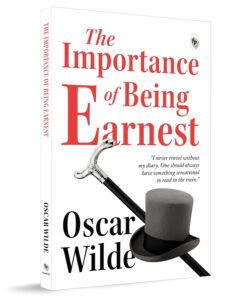
The Importance of Being Earnest
by Oscar Wilde
“A dazzling ‘trivial comedy for serious people’ that masterfully skewers Victorian society’s hypocrisies, superficiality, and rigid conventions through a labyrinth of mistaken identities, witty paradoxes, and the pursuit of a most desirable name.”
Table of Contents
ToggleOverview
Oscar Wilde’s “The Importance of Being Earnest: A Trivial Comedy for Serious People” stands as a quintessential masterpiece of English theatre, a scintillating satire first performed in 1895.
Set against the backdrop of late Victorian high society, the play meticulously dissects the era’s rigid social codes, its obsession with appearances, and the inherent hypocrisy that underpinned its moralistic façade.
Wilde, a master of wit and paradox, crafts a narrative where the trivial is treated with utmost seriousness, and matters of profound importance are dismissed with a flippant quip, thereby exposing the inherent absurdities of his contemporary world.
At its heart, the play revolves around the elaborate deceptions employed by its two protagonists, Jack Worthing and Algernon Moncrieff, to escape their social obligations and pursue romantic interests. Jack, a seemingly respectable country gentleman, invents an invalid younger brother named ‘Ernest’ whose frequent misadventures provide him with an excuse to travel to London and indulge in a more hedonistic lifestyle. Similarly, Algernon, a dandyish bachelor, concocts ‘Bunbury,’ an ailing friend whose sudden relapses offer him convenient alibis to shirk tiresome social engagements.
This intricate web of ‘Bunburying’ forms the comedic engine of the play, leading to a series of mistaken identities, farcical misunderstandings, and ultimately, a profound commentary on the nature of truth, identity, and the performative aspects of social existence. Wilde’s genius lies not merely in the cleverness of his plot, but in the exquisite elegance of his dialogue, which is replete with epigrams, aphorisms, and a relentless stream of sophisticated banter that simultaneously entertains and critiques.
“The Importance of Being Earnest” is more than just a comedy of manners; it is a profound exploration of the human desire for freedom from societal constraints, the arbitrary nature of social status, and the often-superficial motivations behind love and marriage in a class-conscious society. Through its unforgettable characters, particularly the formidable Lady Bracknell, Wilde immortalises a particular moment in history whilst crafting a work whose themes of identity, authenticity, and the pursuit of happiness remain timelessly relevant.
Key Takeaways
The Absurdity of Victorian Social Conventions
Wilde’s play is a scathing, yet exquisitely humorous, critique of the rigid social structures and hypocritical moral codes of late Victorian England.
Through characters like Lady Bracknell, who prioritises wealth, lineage, and superficial ‘connections’ over genuine affection or character, Wilde exposes the arbitrary and often cruel nature of societal expectations.
The entire plot hinges on the characters’ adherence to, and simultaneous subversion of, these conventions, particularly the elaborate deceptions (Bunburying) required to navigate them. The play suggests that the ‘serious’ matters of society – marriage, reputation, class – are, in fact, utterly trivial and based on flimsy pretences, whilst the ‘trivial’ matters, such as a name, are given undue weight.
The Nature of Identity and Deception
Central to the play is the theme of identity, specifically how it is constructed and perceived. Both Jack and Algernon create alter egos (‘Ernest’ and ‘Bunbury’) to escape the constraints of their real lives, highlighting the performative aspect of identity in a society obsessed with appearances.
The name ‘Ernest’ itself becomes a symbol of desired identity, representing a superficial ideal of respectability and charm that both Gwendolen and Cecily are drawn to, regardless of the actual character of the man bearing it.
The play ultimately suggests that identity is fluid, often a construct, and that deception can be a necessary tool for personal freedom within a restrictive social framework. The final revelation that Jack’s real name is indeed Ernest ironically validates the women’s superficial desires whilst simultaneously exposing the absurdity of their criteria.
Love, Marriage, and Superficiality
Wilde satirises the motivations behind love and marriage in Victorian society, portraying them as often driven by convenience, social status, and superficial attractions rather than genuine emotion.
Gwendolen and Cecily are both fixated on marrying a man named ‘Ernest,’ believing the name itself to embody desirable qualities. Their romantic ideals are based on fanciful notions and diary entries, rather than a deep understanding of their fiancés.
Lady Bracknell’s interrogation of Jack regarding his finances and connections, and her swift approval of Cecily’s engagement to Algernon upon learning of her fortune, underscore the transactional nature of marriage amongst the upper classes.
The play suggests that true love, if it exists, must navigate a landscape of social artifice and personal convenience, often finding its resolution through fortunate coincidences rather than profound emotional connection.
Wilde's Wit and Epigrammatic Style
The enduring appeal of “The Importance of Being Earnest” lies significantly in Wilde’s unparalleled mastery of language. The play is a veritable cascade of epigrams, paradoxes, and witty aphorisms that are both intellectually stimulating and uproariously funny.
Characters engage in brilliant, often nonsensical, banter that subverts conventional wisdom and exposes societal absurdities. Wilde’s dialogue is characterised by its elegant precision, its inversion of expectations, and its ability to deliver profound social commentary wrapped in a veneer of light-hearted frivolity.
This distinctive linguistic style not only defines the play’s comedic brilliance but also serves as its primary critical tool, allowing Wilde to critique Victorian values whilst simultaneously entertaining his audience with dazzling verbal pyrotechnics.
The Triviality of Serious Matters and Seriousness of Trivial Matters
This central paradox encapsulates Wilde’s overarching critique. Throughout the play, characters treat genuinely important issues, such as poverty, education, or personal responsibility, with a dismissive flippancy. For instance, Lady Bracknell’s views on education are purely utilitarian and superficial, whilst Algernon’s concern for Bunbury is solely about convenience.
Conversely, trivial matters, such as the precise spelling of a name, the colour of a tea service, or the contents of a diary, are afforded immense gravity and become catalysts for significant plot developments and emotional turmoil.
This inversion highlights the distorted values of a society that prioritises appearance over substance, and convention over genuine human feeling, ultimately suggesting that much of what society deems ‘serious’ is, in fact, a grand performance of triviality.
Chapter Breakdown
Act I: Algernon’s Flat in Half-Moon Street
The play opens in Algernon Moncrieff’s fashionable London flat, where he is being served by his butler, Lane. Algernon’s cynical wit and penchant for paradox are immediately evident as he discusses the nature of marriage and the triviality of life. His friend, Ernest Worthing, arrives, seeking to propose to Algernon’s cousin, Gwendolen Fairfax.
Algernon, however, has discovered an inscription in a cigarette case belonging to ‘Ernest,’ revealing it to be from a ‘little Cecily’ and addressed to ‘Uncle Jack.’ This exposes Jack’s double life: in the country, he is the responsible guardian, Jack Worthing, whilst in London, he adopts the persona of his wicked younger brother, Ernest, to escape his duties and indulge in urban pleasures. This practice, he explains, is his form of ‘Bunburying’ – a term Algernon coined for inventing an invalid friend to provide convenient excuses for avoiding social obligations.
Lady Bracknell, Gwendolen’s formidable mother, and Gwendolen herself arrive. Jack proposes to Gwendolen, who accepts, primarily because she is enamoured with the name ‘Ernest,’ believing it to inspire absolute confidence. Lady Bracknell then subjects Jack to a famously rigorous interrogation regarding his social standing, finances, and, most crucially, his origins. The revelation that Jack was found as a baby in a handbag at Victoria Station’s cloakroom utterly appals Lady Bracknell, who declares him an unsuitable match, famously stating, “To lose one parent, Mr. Worthing, may be regarded as a misfortune; to lose both looks like carelessness.” The act concludes with Algernon, intrigued by Cecily and Jack’s country life, secretly planning to visit Jack’s country estate whilst impersonating the fictitious ‘Ernest’.
Key Points
- Introduction of Algernon Moncrieff, a witty dandy, and his ‘Bunburying’ practice.
- Jack Worthing’s arrival, revealing his double life as ‘Ernest’ in London and ‘Jack’ in the country.
- Jack’s proposal to Gwendolen Fairfax, who is captivated by the name ‘Ernest’.
- Lady Bracknell’s iconic interrogation of Jack, culminating in the shocking revelation of his obscure origins (found in a handbag).
- Algernon’s decision to visit Jack’s country estate, posing as the ‘wicked’ brother Ernest, setting up the central conflict.
Act II: The Garden at the Manor House, Woolton
The scene shifts to Jack’s country estate, where his young ward, Cecily Cardew, is being tutored by the prim Miss Prism. Cecily, a romantic and imaginative girl, is fascinated by the tales of Jack’s wicked brother, Ernest, whom she has never met. She meticulously records her romantic fantasies and the supposed correspondence between herself and Ernest in her diary.
Dr. Chasuble, the local rector, visits, expressing his admiration for Miss Prism. Their interactions provide a gentle, albeit slightly absurd, subplot of burgeoning affection. Algernon arrives, introducing himself to Cecily as ‘Ernest Worthing,’ much to her delight. He quickly charms her, and they become engaged, with Cecily, like Gwendolen, being particularly enamoured with the name ‘Ernest’ and the idea of marrying a man with a dubious past.
Jack returns, dressed in mourning, announcing the death of his brother Ernest in Paris, intending to finally put an end to his deception. He is horrified to discover Algernon posing as Ernest and engaged to Cecily. Shortly after, Gwendolen arrives, having followed Jack from London. She encounters Cecily, and the two women, both believing themselves engaged to ‘Ernest Worthing,’ initially bond over their shared love for a man of such a desirable name. However, when they realise they are engaged to the *same* ‘Ernest,’ their friendship quickly sours into a polite but fierce rivalry, culminating in a comedic confrontation over tea and cake.
Key Points
- Introduction of Cecily Cardew, Jack’s romantic ward, and Miss Prism, her governess, alongside Dr. Chasuble.
- Algernon arrives at the country estate, successfully impersonating ‘Ernest Worthing’ and charming Cecily.
- Cecily, like Gwendolen, falls in love with the idea of ‘Ernest’ and accepts Algernon’s proposal.
- Jack returns, intending to kill off his fictitious brother, only to find Algernon already playing the part.
- Gwendolen’s arrival leads to a farcical confrontation between her and Cecily, as both women believe they are engaged to the same ‘Ernest’.
Act III: The Drawing-Room at the Manor House
The final act opens with the two couples, Jack and Gwendolen, and Algernon and Cecily, in a state of comedic deadlock. The women refuse to marry their respective fiancés unless they can prove they are named ‘Ernest.’ Both Jack and Algernon, in a desperate attempt to satisfy their beloveds, arrange with Dr. Chasuble to be christened ‘Ernest’ that very afternoon.
Lady Bracknell makes an unexpected appearance, having followed Gwendolen. She is initially appalled by Algernon’s engagement to Cecily, but upon learning of Cecily’s considerable fortune, she quickly approves the match. However, she refuses to sanction Jack’s marriage to Gwendolen due to his unknown parentage. Jack then reveals that he is Cecily’s guardian and will not consent to her marriage to Algernon unless Lady Bracknell approves his own union with Gwendolen, creating a stalemate.
The crucial turning point arrives when Miss Prism is identified by Lady Bracknell as the governess who, twenty-eight years prior, mysteriously disappeared with a baby in a perambulator, leaving a three-volume novel in its place. It is revealed that Miss Prism, in a moment of absent-mindedness, had accidentally placed the baby in the handbag and the manuscript in the perambulator, subsequently abandoning the handbag at Victoria Station. Jack, upon hearing this, produces the very handbag, confirming he is the lost infant.
Lady Bracknell then reveals that the baby was her nephew, the son of her late sister and General Moncrieff, making Jack Algernon’s elder brother. Furthermore, she informs him that, as the eldest son, he was christened ‘Ernest John Moncrieff.’ With this revelation, Jack discovers his true identity, his real name is indeed Ernest, and he is of impeccable social standing. All obstacles are removed, and the three couples – Jack and Gwendolen, Algernon and Cecily, and Miss Prism and Dr. Chasuble – are joyfully united, concluding the play with a triumphant affirmation of the importance of being, quite literally, Ernest.
Key Points
- Both Jack and Algernon plan to be christened ‘Ernest’ to appease their fiancées, highlighting the superficiality of their romantic motivations.
- Lady Bracknell arrives, initially disapproving of Algernon and Cecily’s engagement but quickly approving upon learning of Cecily’s wealth.
- A dramatic revelation: Miss Prism is identified as the governess who lost a baby in a handbag twenty-eight years ago.
- Jack produces the handbag, confirming he is the lost baby and, therefore, Lady Bracknell’s nephew and Algernon’s elder brother.
- Jack’s true name is revealed to be Ernest John Moncrieff, fulfilling the play’s central comedic premise and leading to the happy resolution of all three engagements.
Conclusion
Oscar Wilde’s “The Importance of Being Earnest” remains an unparalleled triumph of English dramatic literature, a play that continues to captivate audiences and critics alike with its sparkling wit, intricate plot, and profound social commentary. Upon its debut, it was hailed as a comedic masterpiece, though its deeper satirical bite was perhaps initially overshadowed by its sheer entertainment value. Its critical reception has only grown in stature over the decades, solidifying its position as a cornerstone of the theatrical canon and a definitive example of the ‘comedy of manners’ genre.
The play’s enduring impact stems from its timeless exploration of themes such as identity, authenticity, and the often-absurd nature of societal expectations. Wilde’s genius lies in his ability to craft a narrative that is simultaneously light-hearted and deeply incisive, using humour as a scalpel to dissect the hypocrisies of his age. The memorable characters, from the indomitable Lady Bracknell to the charmingly deceptive Jack and Algernon, have become archetypes, their lines quoted and re-quoted, testament to the play’s indelible mark on popular culture.
Ultimately, “The Importance of Being Earnest” is more than just a period piece; it is a universal examination of human foibles, the masks we wear, and the lengths to which we go to navigate the complexities of social existence. Its sophisticated dialogue, replete with paradox and epigram, ensures its continued relevance, offering both a joyous theatrical experience and a sharp, intellectual critique. It stands as Wilde’s magnum opus, a brilliant and beautiful testament to the power of language and the enduring importance of not taking oneself, or society, too seriously.