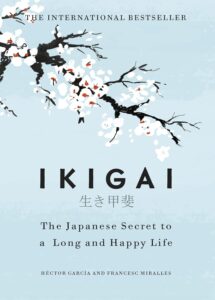
Ikigai: The Japanese Secret to a Long & Happy Life
by Francesc Miralles and Hector Garcia
“Unveiling the ancient Japanese philosophy of ‘ikigai’, this profound guide offers a compelling blueprint for discovering one’s life purpose, fostering longevity, and cultivating enduring happiness through a harmonious blend of passion, mission, vocation, and profession.”
Table of Contents
ToggleOverview
Francesc Miralles and Hector Garcia’s ‘Ikigai: The Japanese Secret to a Long and Happy Life’ delves into the profound Japanese concept of ‘ikigai’, which translates roughly to ‘a reason for being’ or ‘the happiness of always being busy’.
The authors embark on a captivating journey to Okinawa, a Japanese island renowned for its exceptionally high concentration of centenarians, to uncover the secrets behind their remarkable longevity and zest for life.
Through extensive interviews with these vibrant elders, Miralles and Garcia distil a universal philosophy that transcends cultural boundaries.
They meticulously analyse the daily routines, dietary habits, social connections, and psychological outlooks of the Okinawan inhabitants, revealing a consistent pattern of living that prioritises purpose, community, and a mindful approach to existence.
The book posits that finding one’s ikigai is not a grand, singular revelation, but rather a continuous process of self-discovery and engagement with the world.
The narrative weaves together anecdotal evidence from the centenarians with insights from various psychological theories, including Mihaly Csikszentmihalyi’s concept of ‘flow’ and Viktor Frankl’s logotherapy. It explores how maintaining a state of flow – being completely absorbed in an activity – contributes significantly to well-being and a sense of purpose.
Furthermore, the authors introduce practical frameworks and exercises designed to help readers identify their own ikigai, encouraging a holistic approach that integrates personal passions with the needs of the world.
Ultimately, ‘Ikigai’ is more than just a self-help book; it is a cultural exploration and a philosophical treatise on living a meaningful life. It challenges the Western obsession with retirement and constant striving, instead advocating for a life of continuous, joyful engagement.
The book’s gentle yet powerful message resonates deeply, offering a refreshing perspective on how to navigate the complexities of modern life whilst retaining a profound connection to one’s inner purpose and the wider community.
Key Takeaways
The Ikigai Framework
Ikigai is a holistic concept representing the intersection of four fundamental aspects of life: what you love (your passion), what you are good at (your vocation), what the world needs (your mission), and what you can be paid for (your profession). Finding this sweet spot is not about a single, grand purpose, but a continuous journey of self-discovery and alignment.
It encourages individuals to seek meaning and joy in their daily activities, ensuring that their efforts contribute to both personal satisfaction and the greater good. This framework provides a powerful lens through which to evaluate career choices, hobbies, and life goals, guiding one towards a more integrated and fulfilling existence.
Embrace Continuous Engagement and 'Hara Hachi Bu'
The Okinawan centenarians exemplify the principle of never truly retiring, instead maintaining active, purposeful lives well into old age. This ‘staying busy’ is not about relentless work, but about continuous, joyful engagement with meaningful activities. Coupled with this is the dietary wisdom of ‘Hara Hachi Bu’ – eating only until 80% full.
This mindful approach to consumption prevents overeating, promotes digestive health, and contributes to overall longevity. Together, these principles advocate for a life of moderation, sustained activity, and a deep appreciation for the present moment, fostering both physical vitality and mental clarity.
Cultivate Flow and Resilience
Achieving a state of ‘flow’ – complete absorption in an activity where time seems to disappear – is central to experiencing deep satisfaction and contributing to one’s ikigai. This requires balancing challenge with skill, leading to a sense of mastery and intrinsic reward.
Furthermore, the book highlights the importance of psychological resilience, drawing on logotherapy and Morita therapy. It teaches that whilst we cannot control all circumstances or emotions, we can control our actions and choose our attitude.
This enables individuals to find meaning in adversity, grow stronger from challenges (anti-fragility), and maintain a positive outlook, thereby reinforcing their purpose and well-being.
Nurture Community and Connection
The profound significance of strong social bonds and community support is a cornerstone of the ikigai philosophy. The Okinawan ‘moai’ – informal groups of people who provide mutual support – illustrate how deep connections contribute to both longevity and happiness.
Surrounding oneself with good friends, engaging in community activities, and fostering a sense of belonging are vital for emotional well-being and a broader sense of purpose. These social networks offer a crucial buffer against stress, provide collective wisdom, and reinforce the idea that a fulfilling life is often a shared journey, where contributing to others’ well-being enhances one’s own.
Chapter Breakdown
Chapter 1: The Ikigai Concept and the Centenarians of Okinawa
This foundational chapter introduces the core concept of ikigai, defining it as the intersection of what you love, what you are good at, what the world needs, and what you can be paid for. The authors immediately transport the reader to Ogimi, a village in Okinawa, Japan, famously known as the ‘Village of Longevity’ and home to an extraordinary number of centenarians. Here, they begin their ethnographic study, observing and interviewing these remarkable individuals.
Miralles and Garcia highlight that these Okinawan elders do not retire in the conventional Western sense; instead, they maintain an active, purposeful life well into their nineties and beyond. Their daily routines are characterised by a blend of physical activity, social engagement, and a deep connection to their work, often related to farming or traditional crafts. The chapter sets the stage for understanding ikigai not as an abstract ideal, but as a tangible, lived experience deeply embedded in the culture and lifestyle of these long-lived communities.
They emphasise that the Okinawan approach to life is holistic, integrating diet, exercise, social bonds, and a clear sense of purpose. This initial exploration serves to demystify longevity, presenting it not as a matter of genetic luck alone, but as the cumulative result of conscious lifestyle choices and a profound philosophical outlook.
Key Points
- Ikigai is defined as the convergence of passion, mission, vocation, and profession, offering a holistic framework for life’s purpose.
- The chapter introduces Ogimi, Okinawa, as a ‘Village of Longevity’ where centenarians exemplify the practical application of ikigai.
- Okinawan elders demonstrate that continuous engagement and a strong sense of purpose, rather than retirement, contribute significantly to their remarkable longevity and vitality.
Chapter 2: The Ten Rules of Ikigai
Building upon their observations in Okinawa, the authors distil the essence of the centenarians’ wisdom into ten actionable rules for living an ikigai-driven life. These rules serve as practical guidelines, offering a clear pathway to cultivating purpose and well-being. They range from staying active and not retiring, to eating only until 80% full (Hara Hachi Bu), surrounding oneself with good friends, and reconnecting with nature.
Each rule is elaborated with examples from the Okinawan lifestyle, demonstrating how these principles are interwoven into their daily existence. For instance, ‘Don’t worry’ addresses the importance of mental calm and resilience, whilst ‘Get in shape for your next birthday’ encourages continuous self-improvement and a forward-looking perspective. The emphasis is on small, consistent actions that collectively contribute to a fulfilling life.
The chapter underscores that these rules are not rigid commandments but rather flexible principles that can be adapted to individual circumstances. They collectively paint a picture of a life lived with intention, balance, and joy, highlighting the importance of both physical and mental well-being, as well as strong social connections.
Key Points
- The book outlines ten practical rules derived from Okinawan centenarians, including ‘Stay active; don’t retire’ and ‘Eat only until 80% full’ (Hara Hachi Bu).
- These rules emphasise a holistic approach to life, integrating physical activity, mindful eating, strong social bonds, and a positive mental outlook.
- The principles encourage continuous engagement, resilience, and a deep appreciation for life’s simple pleasures, fostering a sustained sense of purpose.
Chapter 3: Finding Flow in Everything You Do
This chapter introduces Mihaly Csikszentmihalyi’s concept of ‘flow’ and demonstrates its profound connection to ikigai. Flow is described as the state of complete absorption in an activity, where one loses track of time, self-consciousness fades, and the task itself becomes intrinsically rewarding. The authors argue that regularly entering a state of flow is crucial for experiencing deep satisfaction and contributing to one’s ikigai.
They explain the conditions necessary for achieving flow: a clear set of goals, immediate feedback, and a balance between the challenge of the task and one’s skill level. When the challenge is too high, anxiety arises; when too low, boredom sets in. The ‘sweet spot’ is where skills are stretched just enough to meet the challenge, leading to a sense of mastery and enjoyment. The Okinawan centenarians, through their dedication to crafts, gardening, and community activities, often exemplify this state of flow.
Miralles and Garcia provide practical advice on how to cultivate more flow in daily life, suggesting ways to structure work and leisure activities to maximise engagement. They highlight that flow is not exclusive to creative pursuits but can be found in mundane tasks when approached with mindfulness and a focus on process rather than just outcome. This integration of flow into everyday existence is presented as a key component of a joyful and purposeful life.
Key Points
- The chapter elucidates Mihaly Csikszentmihalyi’s concept of ‘flow’ – a state of complete absorption and enjoyment in an activity.
- Achieving flow requires a balance between a task’s challenge and one’s skill level, leading to intrinsic motivation and a loss of self-consciousness.
- Readers are encouraged to identify and cultivate activities that induce flow, integrating them into daily routines to enhance satisfaction and contribute to their ikigai.
Chapter 4: Logotherapy, Morita Therapy, and Resilience
Miralles and Garcia delve into psychological frameworks that complement the concept of ikigai, specifically Viktor Frankl’s logotherapy and Shoma Morita’s Morita therapy. Logotherapy, developed by Frankl after his experiences in concentration camps, posits that the primary motivational force in humans is the search for meaning. This resonates deeply with ikigai, as both emphasise the importance of purpose in overcoming adversity and finding joy.
Morita therapy, a Japanese form of psychotherapy, focuses on accepting one’s feelings whilst taking action regardless. It teaches that whilst we cannot control our emotions, we can control our behaviour. This approach fosters resilience and encourages individuals to commit to their responsibilities and purpose, even in the face of discomfort or anxiety. The authors illustrate how the Okinawan elders embody these principles, demonstrating remarkable resilience and a positive outlook despite life’s inevitable challenges.
The chapter stresses the importance of anti-fragility – the ability not just to withstand shocks but to grow stronger from them. By embracing challenges and finding meaning in suffering, individuals can develop a robust inner core that supports their ikigai. This section provides a powerful psychological underpinning for the practical advice offered throughout the book, demonstrating how a strong sense of purpose can act as a buffer against life’s hardships.
Key Points
- The chapter explores Viktor Frankl’s logotherapy, emphasising the human search for meaning as a primary motivator, directly aligning with ikigai.
- Shoma Morita’s Morita therapy is introduced, advocating for accepting emotions whilst focusing on purposeful action, fostering resilience and commitment.
- The authors highlight the concept of anti-fragility, illustrating how embracing challenges and finding meaning in adversity can strengthen one’s sense of purpose and well-being.
Chapter 5: Diet, Exercise, and Movement for Longevity
This chapter focuses on the tangible lifestyle elements that contribute to the Okinawan centenarians’ longevity and vitality: their diet and their approach to physical activity. The authors detail the ‘Hara Hachi Bu’ principle, which advises eating only until one is 80% full, a practice that prevents overeating and promotes digestive health. The Okinawan diet itself is rich in vegetables, legumes, and fish, with minimal processed foods and sugar, providing a balanced intake of nutrients.
Beyond diet, the book explores the centenarians’ consistent, gentle physical activity. Rather than intense workouts, their lives are characterised by constant, low-impact movement – gardening, walking, and performing daily chores. This continuous engagement keeps their bodies agile and strong without causing undue stress. They also practise traditional forms of exercise like tai chi and radio taiso, which promote flexibility, balance, and mental clarity.
The authors underscore that these practices are not seen as chores but as integral, enjoyable parts of life. The emphasis is on integrating movement naturally into one’s day and consuming food mindfully, rather than adhering to strict, temporary regimes. This holistic approach to physical well-being is presented as a fundamental pillar supporting a long and joyful ikigai-driven life.
Key Points
- The Okinawan diet, rich in vegetables, legumes, and fish, is detailed, alongside the ‘Hara Hachi Bu’ principle of eating until 80% full.
- Emphasis is placed on consistent, gentle physical activity, such as gardening and walking, rather than strenuous exercise, to maintain agility and strength.
- The chapter highlights that mindful eating and natural movement are integrated into daily life, contributing significantly to longevity and overall well-being.
Chapter 6: Community, Connection, and Anti-fragility
The profound importance of social connection and community is a recurring theme throughout the book, and this chapter dedicates itself to exploring its nuances. The Okinawan centenarians live within strong, supportive communities, often forming ‘moai’ – informal groups of people with common interests who look out for one another. These moai provide financial, social, and emotional support, acting as a crucial buffer against life’s challenges and fostering a sense of belonging.
The authors argue that these deep social bonds contribute significantly to both mental and physical health, reducing stress and providing a sense of purpose beyond oneself. The act of contributing to one’s community, caring for others, and participating in shared activities reinforces one’s ikigai. It moves beyond individualistic pursuits to embrace a collective well-being, where mutual support is a cornerstone of daily life.
This chapter also revisits the concept of anti-fragility, demonstrating how a strong social network enhances one’s ability to not only withstand adversity but to emerge stronger from it. The collective wisdom and support of a community provide resources and perspectives that an individual might lack, reinforcing the idea that a truly fulfilling life is often a shared one. The book encourages readers to actively cultivate and nurture their own social circles, recognising them as vital components of their personal ikigai.
Key Points
- The chapter highlights the critical role of ‘moai’ – informal social support groups – in Okinawan communities, providing financial, social, and emotional assistance.
- Strong social connections are presented as essential for mental and physical health, fostering a sense of belonging and purpose that extends beyond the individual.
- Community engagement and mutual support are shown to enhance anti-fragility, enabling individuals to collectively overcome adversity and thrive.
Chapter 7: Practical Steps to Finding Your Ikigai
In this concluding practical chapter, Miralles and Garcia synthesise the book’s insights into actionable steps for readers to discover and live their own ikigai. They revisit the ikigai Venn diagram, encouraging self-reflection on what one loves, what one is good at, what the world needs, and what one can be paid for. The emphasis is on a journey of self-discovery, rather than a sudden revelation, suggesting that ikigai can evolve over time.
The authors provide exercises and prompts to help readers identify their passions, skills, and values. They advocate for embracing curiosity, trying new things, and paying attention to moments of flow. The importance of small, consistent actions – ‘micro-ikigai’ – is highlighted, suggesting that even seemingly minor activities can contribute to a larger sense of purpose when approached with intention.
Ultimately, the chapter serves as a call to action, urging readers to integrate the principles of ikigai into their daily lives. It reinforces the idea that a long and happy life is not a matter of luck but a conscious cultivation of purpose, connection, and mindful engagement. The book concludes by empowering individuals to embark on their personal quest for ikigai, promising a richer, more fulfilling existence.
Key Points
- The chapter offers practical exercises and prompts for self-reflection, guiding readers to identify their passions, skills, and values in relation to the ikigai Venn diagram.
- It encourages embracing curiosity, trying new experiences, and paying attention to ‘flow’ moments as pathways to discovering one’s evolving ikigai.
- The authors advocate for integrating ‘micro-ikigai’ – small, intentional actions – into daily life, fostering a continuous journey of purpose and fulfilment.
Conclusion
Francesc Miralles and Hector Garcia’s ‘Ikigai’ is a beautifully crafted exploration of a profound Japanese philosophy, offering far more than a simple self-help guide. It serves as a compelling invitation to re-evaluate our modern pursuits of happiness and success, urging us to look inwards and outwards for a deeper, more sustainable sense of purpose. The book’s strength lies in its blend of ethnographic research, drawing directly from the wisdom of Okinawan centenarians, with accessible psychological theories, making the abstract concept of ikigai tangible and actionable.
The authors successfully demystify longevity, presenting it not as a genetic lottery but as the cumulative outcome of mindful living, continuous engagement, and strong community ties. Their British English prose is elegant and engaging, making complex ideas digestible and inspiring. Whilst some critics might suggest the ‘ten rules’ could be seen as simplistic, their power lies in their universality and the consistent evidence provided by the Okinawan elders.
Ultimately, ‘Ikigai’ is a vital read for anyone seeking a more meaningful existence in an increasingly complex world. It provides a refreshing counter-narrative to the relentless pursuit of material wealth, instead championing the quiet joy of purpose, connection, and a life lived in harmony with oneself and one’s community. Its enduring message is a powerful reminder that the secret to a long and happy life often lies in the simple, consistent pursuit of one’s ‘reason for being’. It is a book that encourages not just reading, but profound reflection and practical application, leaving the reader with a renewed sense of direction and optimism.