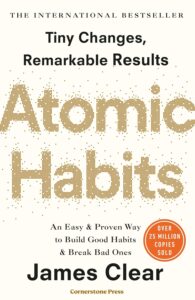
Atomic Habits
by James Clear
“A meticulously crafted guide that demystifies the science of habit formation, offering a practical, step-by-step framework for cultivating positive behaviours and eradicating detrimental ones through minuscule, consistent changes.”
Table of Contents
ToggleOverview
James Clear’s “Atomic Habits” stands as a seminal work in the self-improvement genre, offering a profound yet remarkably accessible framework for understanding and mastering the art of habit formation.
At its core, the book posits that significant, life-altering results are not the product of grand, sweeping changes, but rather the cumulative effect of countless small, seemingly insignificant improvements – what Clear terms “atomic habits.” These tiny, habitual actions, when compounded over time, yield extraordinary outcomes, much like the immense power unleashed from a small atom.
Clear meticulously dismantles the conventional wisdom surrounding habits, shifting the focus from outcome-based goals to identity-based habits. He argues that true, lasting change stems from a fundamental shift in one’s self-perception and beliefs, rather than merely striving for external achievements. The book champions the idea of building systems, not just setting goals, asserting that a robust system for continuous improvement will inevitably lead to desired results, whereas an over-reliance on goals can often lead to frustration and stagnation.
The author, drawing upon a rich tapestry of psychology, biology, and neuroscience, distils the complex mechanisms of habit formation into a clear, actionable four-step model: Make It Obvious, Make It Attractive, Make It Easy, and Make It Satisfying. Each law is explored in depth, providing readers with a comprehensive toolkit of strategies and tactics to implement immediately. Clear’s writing is characterised by its clarity, conciseness, and reliance on compelling anecdotes and scientific evidence, making complex ideas digestible and highly motivational.
“Atomic Habits” is more than just a guide to productivity; it’s a philosophical treatise on the power of incremental progress and the profound impact of self-mastery. It challenges readers to re-evaluate their approach to personal growth, encouraging a patient, persistent, and systematic methodology. The book’s enduring appeal lies in its universal applicability, offering invaluable insights for anyone seeking to optimise their behaviour, whether in personal life, professional pursuits, or creative endeavours, ultimately empowering them to design a life of intentional and sustained improvement.
Key Takeaways
The Power of Atomic Habits
The fundamental insight is that significant change doesn’t require monumental effort but rather the consistent aggregation of marginal gains.
Improving by just 1% each day leads to remarkable, exponential growth over time. These ‘atomic habits’ are small, easy-to-implement actions that, when compounded, create powerful systems for personal transformation. It’s about the cumulative effect of tiny decisions and actions, rather than a single, dramatic overhaul.
Identity-Based Habits
Clear argues that lasting habit change is not about what you want to achieve (outcome-based goals) but about who you want to become (identity-based habits).
By focusing on changing your self-image and believing in the person you aspire to be, your habits naturally align with that identity. This internal shift provides a deeper, more sustainable motivation than external rewards or arbitrary goals, making habits feel less like a chore and more like an affirmation of self.
The Four Laws of Behaviour Change
The book distils habit formation into a practical, actionable framework:
1. Make It Obvious (Cues): Design your environment to make good habits visible and bad habits invisible.
2. Make It Attractive (Craving): Pair desired actions with enjoyable ones, and join communities where good habits are the norm.
3. Make It Easy (Response): Reduce friction, use the Two-Minute Rule, and automate habits.
4. Make It Satisfying (Reward): Track progress, use immediate rewards, and implement accountability. Mastering these laws allows for systematic habit engineering.
Systems Over Goals
While goals provide direction, Clear asserts that it is the system of daily habits that determines progress.
A robust system for continuous improvement will inevitably lead to desired results, whereas an over-reliance on goals can often lead to frustration and stagnation once the goal is achieved or missed.
The focus shifts from the destination to the journey, emphasising the process of consistent effort and refinement as the true driver of success.
Environment Design
Our environment is a powerful, often underestimated, determinant of our habits. Clear provides extensive guidance on how to consciously design your surroundings to make good habits easier and bad habits harder.
This includes placing cues for desired behaviours prominently, removing temptations, and structuring your physical and digital spaces to support your goals. It’s about making the path of least resistance align with your desired actions.
Chapter Breakdown
Chapter 1: The Fundamentals – Why Tiny Changes Make a Big Difference
This foundational section introduces the core philosophy of “Atomic Habits,” emphasising that remarkable results are the culmination of small, consistent improvements. Clear illustrates the concept of compounding, not just in finance, but in personal development, where a mere 1% improvement each day leads to a 37-fold increase in performance over a year. He powerfully argues against the common misconception that success requires monumental shifts, instead advocating for the subtle, persistent power of marginal gains.
The author distinguishes between outcome-based goals and identity-based habits, asserting that true, lasting change originates from a shift in one’s self-image. Rather than focusing on what one wants to achieve, Clear encourages readers to consider who they want to become. This identity-first approach ensures that habits are aligned with a deeper sense of purpose, making them more sustainable and intrinsically motivating. He also introduces the concept of a “system” over a “goal,” explaining that while goals provide direction, it is the system of daily habits that determines progress and ultimately, success.
Key Points
- Small, consistent improvements (1% better each day) compound over time to produce significant, even revolutionary, results.
- True habit change is identity-based, focusing on who you want to become rather than merely what you want to achieve, ensuring deeper motivation and sustainability.
- Prioritise building effective systems for continuous improvement over solely setting ambitious goals, as systems are what drive progress and deliver results.
Chapter 2: The 1st Law – Make It Obvious
The first law of habit change focuses on making cues for desired behaviours impossible to ignore. Clear explains that habits are often triggered by environmental cues, and by consciously designing our surroundings, we can make good habits more likely and bad habits less so. He introduces the ‘Habit Scorecard’ as a tool to become aware of existing habits, many of which operate unconsciously, thereby gaining control over them.
Key strategies include ‘Implementation Intentions,’ which involve clearly defining when and where a new habit will take place (e.g., “I will [BEHAVIOUR] at [TIME] in [LOCATION]”), and ‘Habit Stacking,’ where a new habit is linked to an existing one (e.g., “After I [CURRENT HABIT], I will [NEW HABIT]”). By making the cues for good habits visible and prominent, and conversely, making cues for bad habits invisible, individuals can significantly influence their daily choices and automate positive behaviours.
Key Points
- Increase awareness of existing habits through a ‘Habit Scorecard’ to identify and understand behavioural patterns.
- Design your environment to make cues for good habits obvious and visible, while making cues for bad habits invisible or difficult to access.
- Utilise ‘Implementation Intentions’ (specifying time and location) and ‘Habit Stacking’ (linking new habits to existing ones) to create clear triggers for desired behaviours.
Chapter 3: The 2nd Law – Make It Attractive
This section delves into the motivational aspect of habit formation, asserting that the more attractive a habit is, the more likely we are to perform it. Clear explains that our brains are wired for reward, and dopamine plays a crucial role in the anticipation and craving for pleasurable experiences. He suggests strategies to make good habits more appealing by associating them with positive feelings.
One powerful technique is ‘Temptation Bundling,’ where a desired action is paired with an action you need to do (e.g., “Only watch Netflix while doing laundry”). Clear also highlights the profound influence of social environment, advising readers to join cultures where their desired behaviour is the normal behaviour. By surrounding oneself with people who embody the habits one wishes to adopt, the behaviour becomes not only attractive but also socially reinforced, leveraging our innate desire for belonging and acceptance.
Key Points
- Increase the attractiveness of good habits by associating them with positive experiences and leveraging the brain’s dopamine reward system.
- Employ ‘Temptation Bundling’ by pairing an action you want to do with an action you need to do, making the necessary habit more appealing.
- Join social environments and groups where your desired behaviours are the norm, as our habits are heavily influenced by the people we surround ourselves with.
Chapter 4: The 3rd Law – Make It Easy
The third law focuses on reducing the friction associated with good habits, making them so effortless that they require minimal willpower. Clear argues that human behaviour follows the path of least resistance, and by optimising our environment, we can make desired actions the easiest option. He introduces the concept of ‘decisive moments,’ small choices that have a disproportionately large impact on the rest of the day, such as preparing healthy food in advance.
A cornerstone of this law is the ‘Two-Minute Rule,’ which dictates that any new habit should be started in a way that takes less than two minutes to complete. This reduces the initial barrier to entry, making it easier to begin and build momentum, even if the full habit is more complex. Clear also advocates for ‘automating habits’ through technology and one-time choices (e.g., setting up automatic savings, buying comfortable running shoes), thereby removing the need for daily decision-making and willpower.
Key Points
- Reduce the friction associated with good habits by making them as easy and convenient as possible, leveraging the path of least resistance.
- Implement the ‘Two-Minute Rule’ by ensuring any new habit can be started in under two minutes, thereby overcoming initial inertia and building consistency.
- Automate good habits through technology and smart one-time choices to eliminate the need for daily willpower and decision-making.
Chapter 5: The 4th Law – Make It Satisfying
The final law addresses the critical element of satisfaction, explaining that behaviours followed by immediate gratification are more likely to be repeated. Clear highlights the inherent conflict between short-term pleasure and long-term rewards, noting that bad habits often provide immediate satisfaction, while good habits offer delayed benefits. To counteract this, he proposes strategies to make the rewards of good habits more immediate and tangible.
‘Habit Trackers’ are presented as a simple yet powerful tool, providing visual proof of progress and creating a satisfying sense of accomplishment. The act of marking off a day reinforces the behaviour and motivates continuation. Clear also suggests creating an ‘accountability partner’ or ‘habit contract’ to introduce an immediate cost to missing a habit, thereby making inaction less satisfying. The principle is to ensure that the feeling of success is immediate, even if the ultimate reward is distant, thereby closing the feedback loop and reinforcing the positive behaviour.
Key Points
- Ensure good habits are immediately satisfying to increase their likelihood of repetition, counteracting the brain’s preference for instant gratification.
- Utilise ‘Habit Trackers’ to provide visual proof of progress, creating an immediate sense of accomplishment and reinforcing the desired behaviour.
- Implement an ‘accountability partner’ or ‘habit contract’ to introduce an immediate cost for missing a habit, making inaction less satisfying and promoting consistency.
Chapter 6: Advanced Tactics – How to Go From Good to Great
This concluding section moves beyond the four laws, offering sophisticated strategies for optimising habits and sustaining long-term growth. Clear introduces ‘The Goldilocks Rule,’ which states that humans are most motivated when working on tasks of optimal difficulty – not too hard to be discouraging, and not too easy to be boring. This principle is crucial for maintaining engagement and preventing plateaus in performance.
He also delves into the importance of ‘finding your niche’ and choosing habits that align with your natural talents and personality, thereby increasing the likelihood of success and enjoyment. Clear warns against the potential downsides of good habits, such as becoming complacent or rigid, and stresses the importance of regular ‘review and adjustment.’ This involves periodic reflection on one’s habits and systems to ensure they remain effective and aligned with evolving goals and identity. The ultimate message is one of continuous refinement and adaptation, ensuring that atomic habits remain powerful tools for lifelong improvement.
Key Points
- Apply ‘The Goldilocks Rule’ by engaging in tasks that are optimally challenging – neither too easy nor too difficult – to maintain motivation and prevent boredom or discouragement.
- Focus on habits that align with your natural strengths and personality, increasing the likelihood of sustained effort and enjoyment.
- Regularly review and adjust your habits and systems to prevent complacency, adapt to changing circumstances, and ensure continuous improvement towards your evolving identity.
Conclusion
James Clear’s “Atomic Habits” is a tour de force in the realm of personal development, a meticulously researched and eminently practical guide that has deservedly earned its place as a modern classic. Its enduring appeal lies in its elegant simplicity and profound applicability, offering a universal framework for anyone seeking to cultivate positive behaviours and dismantle detrimental ones. Clear’s ability to synthesise complex psychological and neurological principles into actionable, digestible strategies is a testament to his mastery of the subject.
The book’s impact is undeniable, having resonated with millions globally, from business leaders and athletes to students and homemakers. Its central thesis – that meaningful change is the product of small, consistent improvements – is not merely motivational rhetoric but a scientifically grounded truth, presented with clarity and compelling evidence. The four laws of behaviour change provide a robust, systematic approach that empowers readers to become architects of their own habits, rather than passive recipients of circumstance.
While some critics might argue that the concepts of habit formation are not entirely novel, Clear’s genius lies in his unparalleled ability to organise, articulate, and illustrate these ideas with such precision and practical utility. He doesn’t just tell you what to do; he meticulously explains why it works and how to implement it, replete with relatable anecdotes and actionable advice. “Atomic Habits” is more than a book; it’s a manual for self-mastery, a blueprint for designing a life of intentional growth and sustained excellence. It is, without reservation, an indispensable resource for anyone committed to unlocking their full potential and building a better future, one atomic habit at a time.