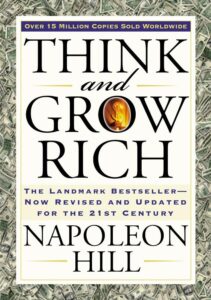
Think And Grow Rich
By Napoleon Hill
“Unveiling the timeless principles of personal achievement and wealth creation, this seminal work distills decades of research into a practical philosophy for transforming desire into reality.”
Table of Contents
ToggleOverview
Napoleon Hill’s “Think and Grow Rich” stands as a monumental work in the self-help and personal development genre, a testament to the power of the human mind to achieve extraordinary success.
Commissioned by industrialist Andrew Carnegie, who challenged Hill to interview hundreds of the most successful individuals of his era, the book synthesizes over two decades of research into a cohesive philosophy of achievement.
It posits that the principles of success are not accidental but follow a discernible pattern, accessible to anyone willing to study and apply them.
The book’s core premise transcends mere financial wealth, though that is often its most visible manifestation. Hill argues that “riches” encompass not only monetary gain but also spiritual, mental, and physical well-being.
The philosophy is built upon the idea that thoughts, when coupled with strong desire, faith, and persistent action, possess a potent energy capable of materializing into their physical equivalent. It challenges the reader to move beyond passive wishing to active, deliberate creation.
Hill meticulously outlines thirteen distinct principles, each building upon the last, forming a comprehensive blueprint for success. These principles are not abstract theories but practical steps, illustrated with anecdotes and examples from the lives of figures like Henry Ford, Thomas Edison, and Theodore Roosevelt.
The book emphasizes the critical role of a definite purpose, the cultivation of a positive mental attitude, the power of the subconscious mind, and the strategic collaboration with others.
Published in 1937, amidst the Great Depression, “Think and Grow Rich” offered a beacon of hope and a practical guide for recovery and prosperity. Its enduring relevance lies in its psychological depth, asserting that the primary battleground for success is within one’s own mind.
It remains a foundational text for entrepreneurs, leaders, and individuals seeking to master their destiny, demonstrating that the journey to riches begins with a thought, nurtured by desire, and propelled by unwavering faith and action.
Key Takeaways
The Power of a Definite Purpose and Burning Desire
Hill unequivocally states that all achievement begins with a clear, unwavering, and emotionally charged desire for a definite purpose.
This isn’t a mere wish but an intense, almost obsessive commitment that fuels all subsequent actions. Without this foundational ‘burning desire,’ the other principles lack the necessary impetus to manifest results. It’s about knowing precisely what you want and having an unshakeable resolve to attain it, regardless of obstacles.
Mindset as the Master Key to Success
The book fundamentally argues that success is an inside job. It’s not primarily about external circumstances, but about the cultivation of a specific mental attitude.
Principles like Faith, Auto-suggestion, and the Subconscious Mind emphasize that by controlling and directing one’s thoughts, one can program their mind for success, overcome limiting beliefs, and attract desired outcomes. The mind is presented as the most powerful tool, capable of transforming thoughts into tangible reality.
The Indispensable Role of the Master Mind Principle
Hill champions the concept of the ‘Master Mind’ group – a harmonious alliance of two or more individuals working towards a common definite purpose.
This principle underscores the power of synergy, collective intelligence, and mutual support. It suggests that the combined mental energy and specialized knowledge of a group, when operating in harmony, create a force far greater than the sum of its individual parts, leading to amplified creativity, problem-solving, and achievement.
Action-Oriented Application of Principles
While emphasizing mental preparation, Hill’s philosophy is intensely practical and action-oriented. Principles like Organized Planning, Decision, and Persistence highlight that desire and faith must be translated into concrete, systematic steps and unwavering effort.
The book provides a blueprint for moving from thought to execution, stressing the importance of making swift decisions, adapting to setbacks, and maintaining relentless persistence until the desired goal is achieved. It’s a call to disciplined, consistent action.
Chapter Breakdown
Introduction: The Man Who 'Thought' His Way Into Partnership With Edison
The introduction sets the stage by immediately illustrating the book’s central thesis through the compelling story of Edwin C. Barnes. Barnes, despite lacking money and formal education, possessed an unshakeable, burning desire to work with Thomas Edison. He didn’t just wish for it; he formulated a definite plan and persisted against all odds, eventually securing a position and proving his worth.
This anecdote serves as a powerful opening, demonstrating that a strong, unwavering desire, coupled with faith and persistence, can overcome seemingly insurmountable obstacles. It introduces the concept that thoughts, when charged with emotion and purpose, are potent forces capable of manifesting in reality. Barnes’s journey from an unknown, penniless man to Edison’s partner exemplifies the very principles the book will systematically unpack.
The introduction thus primes the reader for the profound psychological and philosophical journey ahead, emphasizing that the path to achievement begins not with external circumstances, but with an internal conviction and a definitive mental attitude.
Key Points
- Illustrates the power of a ‘burning desire’ through the story of Edwin C. Barnes and his determination to work with Thomas Edison.
- Establishes the core premise that thoughts, when combined with strong desire and persistence, can materialize into their physical equivalent.
- Highlights that lack of resources or formal education are not barriers when a definite purpose and unwavering faith are present.
Chapter 1: Desire - The Starting Point of All Achievement
Hill asserts that a mere wish is insufficient; one must possess a “burning desire” for a definite purpose. This desire must be so intense that it becomes an obsession, driving all thoughts and actions. He provides a six-step method for transforming this desire into its monetary equivalent, which includes fixing the exact amount of money desired, determining what one intends to give in return, establishing a definite date for its attainment, creating a detailed plan, and then reading this statement aloud twice daily.
This chapter emphasizes that the starting point of all achievement is not a vague hope but a clear, unwavering, and emotionally charged desire. It’s about committing fully to a goal, making it the central focus of one’s existence, and refusing to accept failure. The intensity of this desire is what fuels the subsequent principles, providing the necessary motivation and persistence.
Without this foundational burning desire, Hill argues, all other principles will lack the necessary impetus to be effective. It’s the emotional fuel that ignites the engine of personal achievement, transforming abstract wishes into concrete, actionable goals.
Key Points
- A ‘burning desire’ for a definite purpose is the absolute starting point for all achievement, far beyond a mere wish.
- Outlines a six-step method for transforming desire into its monetary equivalent, involving specific amounts, timelines, and daily affirmations.
- Emphasizes that this intense desire must become an obsession, driving all thoughts and actions, and serving as the emotional fuel for persistence.
Chapter 2: Faith - Visualization and Belief in the Attainment of Desire
Faith, in Hill’s philosophy, is not a religious concept but a state of mind that can be induced and developed through auto-suggestion. It is the firm belief in the attainment of one’s desires, even when there is no tangible evidence yet. Hill explains that the subconscious mind, which acts upon thoughts impressed upon it, cannot distinguish between constructive and destructive impulses, making it crucial to feed it with positive, faith-filled thoughts.
This chapter stresses the importance of visualizing oneself already in possession of the desired outcome. By repeatedly affirming and visualizing, one impresses these thoughts onto the subconscious mind, which then works to bring them into reality. Faith is presented as the “eternal elixir” that gives life, power, and action to the impulse of thought, transforming it into a spiritual counterpart that the subconscious can grasp.
Cultivating faith involves eliminating fear and doubt, replacing them with unwavering belief. It is the bridge between the finite mind of man and Infinite Intelligence, allowing one to tap into a higher power to achieve their goals. Hill provides practical advice on how to develop this state of mind, primarily through auto-suggestion and the repetition of positive affirmations.
Key Points
- Defines faith as a state of mind, not religious belief, that can be induced through auto-suggestion and visualization.
- Explains that the subconscious mind acts upon thoughts impressed upon it, making it crucial to feed it with positive, faith-filled impulses.
- Highlights faith as the ‘eternal elixir’ that gives life and power to thoughts, transforming them into a spiritual counterpart for the subconscious to manifest.
Chapter 3: Auto-Suggestion - The Medium for Influencing the Subconscious Mind
Auto-suggestion is the process by which individuals consciously feed their subconscious mind with thoughts, whether positive or negative. Hill explains that the subconscious mind is highly impressionable and acts upon the dominant thoughts it receives. Therefore, to cultivate faith and achieve one’s desires, it is essential to deliberately and repeatedly impress positive, goal-oriented thoughts upon it.
This chapter provides practical instructions on how to use auto-suggestion effectively. It involves reading aloud one’s written statement of desire, visualizing oneself already in possession of the desired outcome, and doing so with intense emotion and belief. The repetition and emotional charge are crucial, as they help bypass the conscious mind’s skepticism and directly influence the subconscious.
Auto-suggestion is presented as the control mechanism through which one can communicate with their subconscious mind. It is the bridge between the conscious desire and the subconscious’s power to manifest. By mastering this principle, individuals can program their minds for success, overcoming limiting beliefs and fears that might otherwise hinder their progress.
Key Points
- Auto-suggestion is the conscious process of feeding the subconscious mind with specific thoughts, which then influences actions and outcomes.
- Emphasizes the importance of repetition and emotional intensity when impressing desires upon the subconscious mind.
- Serves as the crucial link between conscious desire and the subconscious’s power to manifest, allowing individuals to program their minds for success.
Chapter 4: Specialized Knowledge - Personal Experiences or Observations
Hill distinguishes between general knowledge and specialized knowledge. General knowledge, while useful, is rarely a source of great wealth. Specialized knowledge, on the other hand, is highly focused, organized, and applied directly to a definite purpose. He argues that successful individuals do not necessarily possess all knowledge themselves but know where to find and how to organize specialized knowledge for their specific needs.
This chapter stresses that education is not merely about accumulating facts but about learning how to acquire and apply specialized knowledge. It encourages continuous learning and the development of expertise in one’s chosen field. Hill provides examples of successful people who either acquired specialized knowledge themselves or surrounded themselves with experts who possessed it.
The key takeaway is that one must identify the specific knowledge required to achieve their definite purpose and then actively pursue its acquisition, whether through formal education, self-study, or collaboration. It’s about being resourceful and understanding that knowledge is power only when it is organized and intelligently directed toward a specific end.
Key Points
- Distinguishes between general knowledge (rarely a source of wealth) and specialized knowledge (highly focused and applied to a definite purpose).
- Highlights that successful individuals know how to acquire and organize specialized knowledge, even if they don’t possess all of it personally.
- Emphasizes continuous learning and the strategic application of expertise as crucial for achieving one’s definite purpose.
Chapter 5: Imagination - The Workshop of the Mind
Imagination is presented as the most marvelous, miraculous, and inconceivably powerful force the world has ever known. Hill describes it as the workshop of the mind, where all plans are created and all desires are given form. He differentiates between two forms: Synthetic Imagination, which rearranges old concepts into new combinations, and Creative Imagination, which allows direct communication with Infinite Intelligence, originating new ideas and inspirations.
This chapter underscores that all material achievements begin as an idea in the imagination. It is the faculty through which desire is given shape and form, and plans for its realization are conceived. Hill encourages readers to actively cultivate and use their imagination, seeing it as the tool for innovation and problem-solving.
To effectively use imagination, one must be able to visualize their desires clearly and vividly, allowing the mind to construct the necessary plans and pathways. It is the birthplace of all invention, all art, and all success, making its development paramount for anyone seeking to achieve great things.
Key Points
- Defines imagination as the ‘workshop of the mind’ where all plans are created and desires are given form.
- Differentiates between Synthetic Imagination (rearranging old concepts) and Creative Imagination (originating new ideas from Infinite Intelligence).
- Stresses that all material achievements begin as an idea in the imagination, making its active cultivation essential for innovation and problem-solving.
Chapter 6: Organized Planning - The Crystallization of Desire into Action
This chapter moves from conceptualization to execution, emphasizing that desire and imagination are useless without concrete, organized plans. Hill provides a four-step method for creating practical plans: forming a Master Mind group, determining the services one can offer, meeting with the Master Mind group regularly, and maintaining perfect harmony within the group. He stresses the importance of flexibility, acknowledging that initial plans may fail and require revision.
Organized planning is about translating abstract desires into actionable steps. It requires careful thought, research, and often, the input of others. Hill warns against procrastination and encourages immediate action on plans, even if they are imperfect. The process involves constant evaluation and adaptation, learning from failures, and refining strategies until success is achieved.
Ultimately, this principle is about taking responsibility for one’s goals and systematically working towards them. It’s the bridge between thought and reality, ensuring that the burning desire is channeled into productive, measurable actions rather than remaining a mere dream.
Key Points
- Emphasizes that desire and imagination are ineffective without concrete, organized plans for their realization.
- Outlines a four-step method for creating practical plans, including forming a Master Mind group and maintaining harmony within it.
- Stresses the importance of flexibility, continuous evaluation, and immediate action on plans, even if they are imperfect, to avoid procrastination.
Chapter 7: Decision - The Mastery of Procrastination
Hill identifies indecision as a major cause of failure, particularly among those who accumulate great wealth. He observes that successful individuals make decisions quickly and change them slowly, if at all, while failures tend to make decisions slowly and change them quickly and often. This chapter highlights the critical importance of developing the habit of making firm, swift decisions.
Decision-making is presented as a skill that improves with practice. It requires courage, conviction, and a clear understanding of one’s definite purpose. Hill advises against being swayed by the opinions of others, especially those who lack the same level of ambition or understanding. He emphasizes that listening to too many opinions can lead to confusion and indecision.
This principle is about taking control and asserting one’s will. It’s the point where one commits to a course of action and eliminates the possibility of retreat. The ability to make definite decisions is a hallmark of leadership and a crucial step in translating desire into tangible results, effectively mastering the destructive habit of procrastination.
Key Points
- Identifies indecision as a primary cause of failure, contrasting it with the swift, firm decisions made by successful individuals.
- Stresses the importance of developing the habit of making quick, definite decisions and changing them slowly, if at all.
- Advises against being overly influenced by the opinions of others, especially those who lack the same ambition, as it can lead to confusion and procrastination.
Chapter 8: Persistence - Sustained Effort Necessary to Induce Faith
Persistence is defined as the sustained effort necessary to induce faith in the attainment of one’s desires. It is the unwavering determination to carry through with plans despite obstacles, setbacks, and temporary defeat. Hill argues that persistence is a state of mind that can be cultivated and developed, and it is often the distinguishing factor between success and failure.
This chapter outlines four simple steps to develop persistence: a definite purpose backed by a burning desire, a definite plan, a mind closed to all negative and discouraging influences, and a friendly alliance with one or more persons (Master Mind group) who will encourage one to follow through with the plan. It emphasizes that persistence is not merely stubbornness but a disciplined application of effort.
Persistence is crucial because it tests the strength of one’s desire and faith. Many give up just before achieving their breakthrough. Hill illustrates that every failure carries with it the seed of an equivalent success, and persistence is the tool that unearths that seed. It is the quality that ensures one continues until the goal is achieved.
Key Points
- Defines persistence as the sustained effort required to induce faith and overcome obstacles, distinguishing success from failure.
- Outlines four steps to develop persistence: definite purpose, definite plan, resistance to negative influences, and a supportive Master Mind group.
- Emphasizes that persistence is a cultivated state of mind that ensures one continues through setbacks until the goal is achieved, often just before a breakthrough.
Chapter 9: Power of the Master Mind - The Driving Force
The Master Mind principle is defined as the coordination of knowledge and effort between two or more people, working in perfect harmony, for the attainment of a definite purpose. Hill asserts that when two or more minds come together in a spirit of harmony, a third, invisible, intangible force, a “Master Mind,” is created, which is more powerful than the sum of its individual parts.
This chapter explains that the Master Mind group provides not only specialized knowledge and diverse perspectives but also mutual encouragement and support. It amplifies creative energy and problem-solving capabilities. Hill points to the success of figures like Andrew Carnegie, who surrounded himself with a Master Mind group of highly capable individuals.
Forming a Master Mind alliance is crucial for leveraging collective intelligence and willpower. It helps overcome personal limitations, provides accountability, and generates new ideas that might not emerge from individual effort. The principle underscores the power of synergy and collaboration in achieving significant goals.
Key Points
- Defines the Master Mind as the coordination of knowledge and effort between two or more people in perfect harmony for a definite purpose.
- Explains that a Master Mind group creates a synergistic, more powerful force than the sum of its individual members, amplifying creative energy.
- Highlights the importance of such an alliance for leveraging collective intelligence, overcoming personal limitations, and providing mutual support and accountability.
Chapter 10: The Mystery of Sex Transmutation - The Tenth Step Toward Riches
Hill presents sex transmutation not as a suppression of sexual energy but as its redirection from physical expression into other forms of creative and constructive endeavor. He argues that sexual energy is the most powerful and potent of all human emotions, capable of stimulating the mind to a higher degree of vibratory action. When transmuted, this energy can be channeled into artistic, intellectual, or business pursuits.
This chapter explains that individuals who have learned to harness and redirect this powerful life force often exhibit heightened imagination, courage, willpower, persistence, and creative ability. Hill observes that many highly successful individuals throughout history were driven by this transmuted energy, using it to fuel their ambitions and achieve extraordinary feats.
The principle suggests that by consciously diverting this potent energy, one can significantly enhance their mental and creative faculties, leading to greater focus, determination, and innovative thinking. It’s about recognizing the inherent power within and consciously directing it towards the attainment of one’s definite purpose, rather than allowing it to be dissipated.
Key Points
- Defines sex transmutation as the redirection of powerful sexual energy from physical expression into creative and constructive endeavors.
- Argues that this transmuted energy significantly enhances mental faculties, including imagination, courage, willpower, and creative ability.
- Suggests that consciously channeling this potent life force is a key factor in the achievements of many highly successful individuals throughout history.
Chapter 11: The Subconscious Mind - The Connecting Link
The subconscious mind is presented as a vast, powerful reservoir of mental energy that acts upon the thoughts and emotions impressed upon it, whether positive or negative. Hill describes it as the connecting link between the finite mind of man and Infinite Intelligence. It works tirelessly, day and night, translating thought impulses into their physical equivalent, without questioning their validity.
This chapter emphasizes that the subconscious mind cannot distinguish between constructive and destructive impulses, making it crucial to feed it with positive, faith-filled thoughts through auto-suggestion. It is the storehouse of all memories and experiences, and it influences habits, beliefs, and actions. By consciously directing the subconscious, one can overcome limiting beliefs and manifest desired outcomes.
Understanding and utilizing the subconscious mind is vital because it is the mechanism through which desires are ultimately realized. It is the power that takes the blueprint of desire and works to construct its physical manifestation, making it essential to keep it free from negative influences and consistently impress it with a definite purpose.
Key Points
- Describes the subconscious mind as a powerful reservoir that acts upon all thoughts and emotions impressed upon it, without distinguishing between positive or negative.
- Highlights its role as the connecting link between the finite human mind and Infinite Intelligence, working tirelessly to translate thoughts into physical reality.
- Stresses the importance of consciously feeding the subconscious with positive, faith-filled thoughts through auto-suggestion to overcome limiting beliefs and manifest desired outcomes.
Chapter 12: The Brain - A Broadcasting and Receiving Station for Thought
Hill posits that the human brain is not merely an organ but a broadcasting and receiving station for thought. He suggests that every brain is capable of picking up thought vibrations released by other brains, and that it can also transmit its own thoughts. This concept aligns with the idea of a universal mind or Infinite Intelligence, which the brain can tap into.
This chapter delves into the idea that thoughts are not confined to the individual mind but are energetic forces that can be transmitted and received. It explains how the subconscious mind acts as the ‘sending station’ for thoughts, while the creative imagination serves as the ‘receiving set’ for ideas and inspirations from the universal mind or other individuals.
The principle encourages individuals to cultivate a receptive state of mind, particularly through the use of the Sixth Sense, to tune into valuable ideas and insights. It reinforces the interconnectedness of minds and the potential for tapping into a vast network of intelligence, especially through the harmonious interaction of a Master Mind group.
Key Points
- Proposes that the human brain functions as a broadcasting and receiving station for thought, capable of transmitting and receiving thought vibrations.
- Explains that the subconscious mind acts as the ‘sending station’ and creative imagination as the ‘receiving set’ for ideas from a universal mind or other individuals.
- Encourages cultivating a receptive state of mind to tap into valuable insights and reinforces the interconnectedness of minds, especially within a Master Mind group.
Chapter 13: The Sixth Sense - The Door to the Temple of Wisdom
The Sixth Sense is presented as the apex of Hill’s philosophy, the culmination of all the preceding principles. It is described as the faculty through which Infinite Intelligence may be communicated to the mind, without any conscious effort or will. It is the faculty of intuition, hunches, and inspiration, often referred to as the ‘still, small voice’ or ‘guardian angel.’
This chapter explains that the Sixth Sense is developed only after mastering and applying the other twelve principles. It is not something one can simply decide to use; rather, it emerges as a result of consistent practice and alignment with the principles of success. It is the point where one’s mind becomes receptive to ideas and insights that transcend ordinary reasoning.
The Sixth Sense is the ultimate tool for decision-making and problem-solving, providing guidance and foresight that cannot be obtained through logic alone. It represents a direct connection to a higher form of intelligence, allowing individuals to navigate challenges and seize opportunities with an almost supernatural clarity. It is the ‘door to the temple of wisdom,’ opening up new dimensions of understanding and achievement.
Key Points
- Describes the Sixth Sense as the apex of the philosophy, representing intuition, hunches, and inspiration communicated from Infinite Intelligence without conscious effort.
- Explains that this faculty develops only after mastering and consistently applying the preceding twelve principles, emerging as a result of alignment with success principles.
- Highlights the Sixth Sense as the ultimate tool for decision-making and problem-solving, providing guidance and foresight beyond ordinary reasoning and connecting one to a higher intelligence.
Conclusion
Napoleon Hill’s “Think and Grow Rich” remains an unparalleled classic in the realm of personal development, a profound exploration into the psychology of achievement that transcends its initial publication context.
Its enduring impact stems from its systematic approach, presenting a philosophy of success not as a matter of luck or circumstance, but as a learnable, repeatable process based on definite principles.
Hill’s meticulous research, drawing from the lives of America’s most successful figures, lends a powerful credibility to his assertions, making the book both inspirational and deeply practical. The book’s genius lies in its ability to demystify success, breaking it down into actionable mental and physical steps.
While often associated with financial wealth, its core message is far broader, advocating for the cultivation of a mindset that can achieve any definite purpose, whether it be in business, relationships, or personal well-being. It champions the power of the individual mind, asserting that our thoughts, when imbued with burning desire and unwavering faith, possess an almost alchemical ability to manifest reality.
Despite its age, the principles outlined by Hill—from the power of desire and faith to the importance of organized planning and the Master Mind—remain remarkably relevant in today’s rapidly changing world. It continues to be a foundational text for entrepreneurs, leaders, and anyone seeking to unlock their full potential.
“Think and Grow Rich” is more than a book; it is a timeless manual for self-mastery and a testament to the extraordinary capabilities of the human spirit when guided by a clear vision and indomitable will.
Its legacy is cemented as a definitive guide to transforming ambition into tangible accomplishment.