
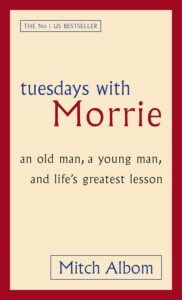
Tuesdays with Morrie
by Mitch Albom
“A touching memoir chronicling a dying professor’s final lessons on life, love, and meaning, delivered through a series of intimate Tuesday conversations with his former student.”
Table of Contents
ToggleOverview
Mitch Albom’s “Tuesdays with Morrie” stands as a profoundly moving and introspective memoir, documenting the author’s rekindled relationship with his former university professor, Morrie Schwartz, during the final months of Morrie’s life.
Diagnosed with Amyotrophic Lateral Sclerosis (ALS), a debilitating neurodegenerative disease, Morrie faces his impending death with an extraordinary blend of courage, wisdom, and an unwavering commitment to living fully until his last breath.
The book, structured as a series of fourteen Tuesday meetings, serves as a final, informal ‘class’ on the meaning of life, with Morrie as the sage instructor and Mitch, a successful yet unfulfilled sports journalist, as the eager, if initially cynical, student.
Albom masterfully weaves together Morrie’s present-day struggle with ALS, his philosophical insights, and flashbacks to their initial student-teacher dynamic at Brandeis University. This narrative technique not only provides depth to Morrie’s character but also highlights the profound transformation Mitch undergoes. Initially driven by career ambition and material success, Mitch finds himself increasingly drawn into Morrie’s world, where the true currency is human connection, compassion, and self-awareness. The book explores universal themes of death, ageing, forgiveness, family, emotions, and the pervasive influence of culture, offering a powerful counter-narrative to the often superficial values of modern society.
Morrie’s ‘curriculum’ is not theoretical; it is lived experience, articulated with a disarming honesty and vulnerability. He confronts his physical decline head-on, using his own body as a living laboratory for understanding the human condition. His lessons are not prescriptive but rather an invitation to reflect on one’s own life choices and priorities.
The book’s enduring appeal lies in its ability to distil complex philosophical questions into accessible, heartfelt dialogue, making it a powerful meditation on what truly matters when faced with the ultimate deadline. It challenges readers to examine their own ‘culture’ and to cultivate a life rich in love, purpose, and genuine connection, rather than succumbing to societal pressures.
Key Takeaways
Embrace Death to Live Fully
Morrie’s central teaching is that by accepting the inevitability of death, one can truly learn how to live. He argues that fear of death often paralyses people, preventing them from appreciating life’s preciousness.
By confronting mortality, one gains perspective, prioritises what truly matters, and sheds the superficial anxieties that dominate modern existence. This acceptance allows for a deeper engagement with the present moment and a more authentic experience of life.
Create Your Own Culture
Morrie critiques the dominant societal culture for promoting consumerism, materialism, and a fear of ageing. He urges individuals to resist these pressures and instead cultivate a personal ‘culture’ founded on love, compassion, community, and meaningful relationships.
This involves consciously choosing values that bring genuine fulfilment rather than blindly following societal norms, thereby fostering a more authentic and purposeful life.
Love or Perish
The most profound lesson Morrie imparts is the paramount importance of love. He believes that without giving and receiving love, life is meaningless.
Love, in its various forms – familial, platonic, romantic – is the ultimate source of security, comfort, and joy. He teaches that love is an active choice, a continuous investment in human connection that transcends physical presence and even death, leaving an enduring legacy.
Forgive Yourself and Others
Morrie stresses the liberating power of forgiveness. He highlights the emotional burden of holding onto grudges, both against others and against oneself.
Forgiveness is presented not as condoning harmful actions, but as an act of self-preservation, releasing bitterness and allowing for inner peace. This lesson is particularly poignant as Morrie faces his own end, underscoring the urgency of making peace with one’s past and present.
The Importance of Human Connection
Throughout his lessons, Morrie consistently emphasises the irreplaceable value of human connection. He contrasts the emptiness of material pursuits with the profound satisfaction derived from genuine relationships.
He teaches that giving to others, being present for loved ones, and fostering a sense of community are the true measures of a rich life. This connection provides support, meaning, and a sense of belonging that no amount of wealth can replicate.
Embrace All Emotions
Morrie advocates for fully experiencing all emotions, rather than suppressing them. He demonstrates that allowing oneself to feel sadness, anger, or fear is not a sign of weakness, but a vital part of the human experience.
By acknowledging and processing these feelings, one can move through them and achieve a deeper appreciation for joy. This approach fosters emotional intelligence and leads to a more authentic and integrated sense of self.
Chapter Breakdown
Chapter 1: The Curriculum: An Introduction
The book opens with a poignant ‘thesis statement’ – a description of Morrie Schwartz’s funeral, immediately establishing the narrative’s melancholic yet hopeful trajectory. Albom then transports the reader back to 1979, introducing Morrie as his charismatic and unconventional sociology professor at Brandeis University. This initial encounter paints a picture of a vibrant, passionate educator who genuinely cared for his students, fostering a unique bond with Mitch, whom he affectionately called ‘Coach’. Morrie’s early advice to Mitch, urging him to be ‘an original’, sets the stage for the profound lessons to come.
Following their graduation, Mitch promises to stay in touch, a promise he fails to keep for sixteen years, becoming engrossed in his career as a successful sports columnist. The narrative then fast-forwards to 1995, revealing Morrie’s diagnosis with Amyotrophic Lateral Sclerosis (ALS), a terminal illness that progressively paralyses the body whilst leaving the mind intact. Mitch, by chance, sees Morrie being interviewed on the television programme ‘Nightline’, sparking a profound sense of guilt and a desire to reconnect with his old mentor before it is too late. This re-establishes the ‘class’ that Mitch had unknowingly signed up for years ago, now with a far more urgent and personal curriculum.
Key Points
- Establishes Morrie Schwartz as Mitch’s beloved and unconventional university professor.
- Reveals Morrie’s diagnosis with ALS, setting the stage for his final lessons on life and death.
- Highlights Mitch’s initial success and subsequent disillusionment, leading to his reunion with Morrie.
Chapter 2: The Student and The Audiovisual
This section delves deeper into Mitch’s character and the circumstances that lead him back to Morrie. We learn of Mitch’s relentless pursuit of professional success following university, sacrificing personal relationships and passions for the sake of his career. His life is a whirlwind of deadlines, travel, and material accumulation, leaving him feeling increasingly empty despite his achievements. The ‘Nightline’ interview, which Mitch stumbles upon whilst flicking through channels, acts as a powerful catalyst, forcing him to confront his own values and the forgotten promise to Morrie.
Morrie, in his ‘Nightline’ appearance, captivates the audience with his candid and philosophical approach to dying. He refuses to hide his illness, instead choosing to embrace it as an opportunity to teach others about living. His openness and lack of self-pity are striking, contrasting sharply with society’s typical fear and avoidance of death. This televised ‘audiovisual’ serves as the initial spark, drawing Mitch back into Morrie’s orbit and setting the stage for their weekly Tuesday meetings, which will become Mitch’s final, most important ‘class’.
Key Points
- Explores Mitch’s post-university life, characterised by career ambition and a growing sense of unfulfilment.
- Details Morrie’s impactful ‘Nightline’ interview, where he openly discusses his terminal illness and philosophy.
- Illustrates how the interview acts as a catalyst for Mitch to reconnect with his dying professor.
Chapter 3: The First Tuesday: We Talk About The World
Mitch’s initial visit to Morrie’s home in West Newton, Massachusetts, is marked by an awkwardness born of years of separation and Mitch’s own discomfort with Morrie’s deteriorating physical state. However, Morrie’s warmth and genuine affection quickly break down these barriers. Their first conversation centres on the world, and Morrie’s observation that people are constantly rushing, chasing the wrong things, and feeling unfulfilled. He laments society’s obsession with material wealth and superficial values, which he believes lead to widespread unhappiness.
Morrie encourages Mitch to develop his own ‘culture’ – a set of values and beliefs that are not dictated by consumerism or media, but by personal conviction and human connection. He argues that if one’s personal culture is strong, it can withstand the pressures of the dominant societal culture. This lesson immediately challenges Mitch’s own life choices, forcing him to confront the emptiness he feels despite his professional success. It’s a powerful opening lesson, setting the tone for the profound re-evaluation that Mitch will undergo.
Key Points
- Morrie highlights society’s misplaced values, particularly the obsession with material wealth and superficiality.
- He advocates for creating one’s own ‘culture’ based on personal values, love, and community.
- This initial lesson directly challenges Mitch’s career-driven lifestyle and prompts self-reflection.
Chapter 4: The Second Tuesday: We Talk About Feeling Sorry for Yourself
As Morrie’s physical condition worsens, he acknowledges the natural inclination to feel sorry for oneself. However, he reveals his own ritual: he allows himself a brief period of mourning each morning, a moment to cry and acknowledge the pain and loss, but then he moves on. He refuses to dwell in self-pity, choosing instead to focus on what he can still do and the joy he can still find in life. This pragmatic approach to suffering is a profound lesson in resilience and emotional management.
Morrie teaches Mitch that whilst it is important to acknowledge pain and sadness, one must not let these emotions consume them. He emphasises the importance of living in the present, finding meaning in small moments, and continuing to engage with the world. His ability to articulate his suffering without succumbing to it offers a powerful example of emotional intelligence and acceptance, demonstrating that even in the face of terminal illness, one can choose how to experience their remaining time.
Key Points
- Morrie shares his method of acknowledging grief and self-pity for a short period, then moving on.
- He teaches the importance of not allowing negative emotions to consume one’s life.
- The lesson underscores resilience and the choice to find joy and meaning despite suffering.
Chapter 5: The Third Tuesday: We Talk About Regrets
Morrie believes that many people live with deep regrets, often only realising them when it is too late. He advises Mitch to take stock of his life and address any unresolved issues before they become burdens. His own impending death has given him a unique perspective, allowing him to see clearly what truly matters. He encourages Mitch to reflect on his own life, asking if he is living the life he truly wants, or if he is merely following societal expectations.
He suggests that people should regularly pause and ask themselves if they are being true to themselves and their values. Morrie’s lesson on regrets is a call to live authentically and to prioritise what brings genuine fulfilment, rather than chasing fleeting desires or external validation. It is a powerful reminder that life is finite, and opportunities for change and reconciliation should be seized whilst they still exist.
Key Points
- Morrie urges Mitch to confront and resolve his regrets before it is too late.
- He advises regular self-reflection to ensure one is living authentically and according to personal values.
- The lesson highlights the importance of prioritising genuine fulfilment over societal expectations.
Chapter 6: The Fourth Tuesday: We Talk About Death
This is perhaps one of the most central and challenging lessons. Morrie confronts death directly, stating that once one learns how to die, they learn how to live. He explains that by accepting the inevitability of death, one can truly appreciate the preciousness of life and shed the fear that often paralyses people. He describes his own process of ‘detachment’, not from life itself, but from the fear of death and the material world.
Morrie’s perspective is that death is a natural part of the life cycle, not something to be feared or ignored. He encourages Mitch to embrace the concept of impermanence, arguing that by acknowledging our mortality, we can live more fully and meaningfully. His calm acceptance of his own demise, whilst still fighting for every breath, offers a profound model for confronting one of humanity’s greatest fears.
Key Points
- Morrie asserts that understanding how to die is essential to truly learning how to live.
- He advocates for ‘detachment’ from fear and material possessions, not from life itself.
- The lesson encourages embracing impermanence and viewing death as a natural part of the life cycle.
Chapter 7: The Fifth Tuesday: We Talk About Family
Morrie stresses the paramount importance of family, describing it as the only true foundation and source of unconditional love. He recounts his own difficult childhood, marked by the early death of his mother and the emotional distance of his father, which instilled in him a deep longing for connection. He contrasts this with the warmth and support he receives from his own wife, Charlotte, and his sons, who provide him with immense comfort and strength during his illness.
He argues that whilst friends are wonderful, family offers a unique and irreplaceable bond that endures through life’s greatest challenges. This lesson resonates deeply with Mitch, who has prioritised his career over his own family relationships. Morrie’s emphasis on the enduring power of family serves as a powerful reminder to cherish and nurture these fundamental connections, as they are the ultimate source of security and love.
Key Points
- Morrie emphasises family as the ultimate source of unconditional love and support.
- He shares his personal experiences to illustrate the profound importance of familial bonds.
- The lesson prompts Mitch to re-evaluate his own priorities regarding his family relationships.
Chapter 8: The Sixth Tuesday: We Talk About Emotions
Morrie encourages Mitch to fully experience all emotions, both positive and negative, rather than suppressing them. He believes that by allowing oneself to feel sadness, fear, or anger, one can then move through them and truly appreciate joy. He demonstrates this by openly weeping and expressing his frustration over his physical decline, yet never allowing these feelings to consume him entirely. He advocates for a balanced approach, where emotions are acknowledged and processed, not ignored.
His philosophy is that true strength lies not in emotional stoicism, but in vulnerability and the capacity to feel deeply. This lesson is particularly impactful for Mitch, who, like many men, has been conditioned to suppress his feelings. Morrie’s example provides a powerful counter-narrative, showing that embracing one’s emotional landscape is crucial for a full and authentic life.
Key Points
- Morrie teaches the importance of fully experiencing and acknowledging all emotions, both positive and negative.
- He demonstrates that true strength lies in vulnerability and processing feelings, rather than suppressing them.
- The lesson challenges societal norms that often encourage emotional stoicism, particularly in men.
Chapter 9: The Seventh Tuesday: We Talk About The Fear of Ageing
Morrie dismisses society’s obsession with youth and the fear of ageing, viewing it as a misguided pursuit. He explains that each stage of life offers unique experiences and wisdom, and that clinging to youth prevents one from embracing the richness of maturity. He expresses a joy in having lived through different ages, stating that if he were young again, he would still choose to be old, because of the knowledge and perspective he has gained.
He argues that those who fear ageing are often those who have not found meaning in their current lives. Morrie’s perspective is liberating, encouraging an acceptance of the natural progression of life and a celebration of the wisdom that comes with age. He sees ageing not as a decline, but as an accumulation of experience and a deeper understanding of oneself and the world.
Key Points
- Morrie rejects society’s fear of ageing, viewing it as a misguided obsession with youth.
- He asserts that each stage of life offers unique value and wisdom, which should be embraced.
- The lesson encourages finding meaning in one’s current age and celebrating the accumulation of life experience.
Chapter 10: The Eighth Tuesday: We Talk About Money
This Tuesday focuses on the pervasive societal belief that money and material possessions bring happiness. Morrie vehemently refutes this, drawing on his own life experience and observing the unhappiness of many wealthy individuals. He argues that material things offer only temporary satisfaction and cannot compensate for a lack of love, compassion, or purpose. He points out that whilst money is necessary for survival, its pursuit beyond basic needs often leads to emptiness and a neglect of what truly matters.
Morrie’s lesson is a powerful critique of consumerism, urging Mitch to re-evaluate his own financial priorities. He suggests that true wealth lies in giving to others, in human connection, and in contributing to something larger than oneself. This conversation is particularly resonant for Mitch, who has spent years chasing financial success, and it forces him to confront the ultimate futility of such a singular pursuit.
Key Points
- Morrie debunks the myth that money and material possessions bring lasting happiness.
- He argues that true wealth is found in human connection, compassion, and giving to others.
- The lesson serves as a critique of consumerism and prompts Mitch to reconsider his financial priorities.
Chapter 11: The Ninth Tuesday: We Talk About How Love Goes On
Morrie’s physical decline is now very advanced, making communication increasingly difficult, yet his message of love remains clear and potent. He explains that love is the most important thing in life, and that it never truly dies. Even after a person is gone, the love they shared and the impact they had on others continues to live on. He speaks of the importance of giving love and receiving it, emphasising that without it, life is meaningless.
This lesson is deeply personal for Morrie, as he reflects on his own relationships and the love he has cultivated throughout his life. He teaches Mitch that the only way to truly live is to give oneself to others, to love them, and to allow oneself to be loved in return. It is a profound affirmation of the enduring power of human connection, transcending even the finality of death.
Key Points
- Morrie asserts that love is the most crucial aspect of life and that it endures beyond death.
- He emphasises the importance of both giving and receiving love for a meaningful existence.
- The lesson serves as a powerful affirmation of human connection’s enduring power.
Chapter 12: The Tenth Tuesday: We Talk About Marriage
Morrie, having been married for decades, shares his insights into the complexities and enduring strength of a good marriage. He identifies several key principles: respect, compromise, open communication, and a shared set of values. He acknowledges that marriage is challenging, requiring constant effort and a willingness to adapt, but he views it as an essential partnership that provides immense support and companionship, especially in times of crisis.
His own marriage to Charlotte serves as a testament to these principles, providing him with unwavering support throughout his illness. Morrie’s advice encourages Mitch to invest deeply in his own relationship, highlighting that a strong marital bond is a vital anchor in a turbulent world. It is a lesson on the practical and emotional labour required to sustain a loving and fulfilling partnership.
Key Points
- Morrie outlines the essential components of a successful marriage: respect, compromise, and open communication.
- He highlights marriage as a vital partnership providing support and companionship through life’s challenges.
- The lesson encourages deep investment in marital relationships as a crucial anchor in life.
Chapter 13: The Eleventh Tuesday: We Talk About Culture
Revisiting a theme from their first Tuesday, Morrie further elaborates on the concept of creating one’s own culture. He argues that the dominant societal culture often promotes superficial values, such as consumerism, celebrity worship, and a fear of ageing and death. He encourages individuals to resist these pressures and instead build a personal culture based on love, community, compassion, and meaningful relationships.
Morrie’s own home, filled with friends, music, and intellectual discourse, serves as an embodiment of his alternative culture. He believes that by actively choosing and nurturing these values, one can live a more authentic and fulfilling life, irrespective of external societal pressures. This lesson is a call to conscious living, urging Mitch and the reader to critically examine the influences shaping their lives and to forge a path aligned with their deepest values.
Key Points
- Morrie reiterates the importance of resisting superficial societal values and creating a personal culture.
- He advocates for a culture founded on love, community, compassion, and meaningful relationships.
- The lesson encourages conscious living and aligning one’s path with deeply held personal values.
Chapter 14: The Twelfth Tuesday: We Talk About Forgiveness
Morrie stresses the critical importance of forgiveness, both for others and for oneself. He recounts a long-standing estrangement with a close friend, Norman, which he deeply regrets. He emphasises that holding onto grudges only harms oneself, and that forgiveness is a liberating act. He also speaks of the necessity of forgiving oneself for past mistakes and shortcomings, a process he is undergoing as he faces his own mortality.
He teaches Mitch that forgiveness is not about condoning harmful actions, but about releasing the emotional burden they impose. This lesson is particularly poignant as Morrie’s time is running out, highlighting the urgency of making peace with oneself and others. It is a powerful message about letting go of bitterness and embracing compassion as a path to inner peace.
Key Points
- Morrie highlights the profound importance of forgiving others and, crucially, oneself.
- He shares his personal regret over an unresolved estrangement, underscoring the urgency of forgiveness.
- The lesson teaches that forgiveness is a liberating act, releasing emotional burdens and fostering inner peace.
Chapter 15: The Thirteenth Tuesday: We Talk About The Perfect Day
As Morrie’s condition deteriorates further, he is asked to describe his perfect day. His vision is surprisingly simple and grounded in everyday pleasures: a modest breakfast, a walk in the park, a meal with friends, dancing to his favourite music, and a quiet evening with his wife. He doesn’t wish for grand adventures or material luxuries, but for moments of genuine connection, sensory pleasure, and shared humanity.
This vision underscores Morrie’s philosophy that true happiness is found not in extraordinary events, but in the appreciation of ordinary moments and the presence of loved ones. It is a powerful testament to living fully in the present and finding joy in the simple, yet profound, aspects of life. His ‘perfect day’ is a blueprint for a life lived with intention and gratitude, even in the shadow of death.
Key Points
- Morrie describes his ‘perfect day’ as simple, focusing on everyday pleasures and human connection.
- His vision highlights that true happiness is found in appreciating ordinary moments and loved ones.
- The lesson serves as a blueprint for living with intention and gratitude, even in the face of mortality.
Chapter 16: The Fourteenth Tuesday: Goodbye
The final Tuesday is a deeply emotional farewell. Morrie is barely able to speak, and Mitch holds his hand, offering comfort and presence. In this silent exchange, the depth of their bond is palpable. Morrie manages to convey his love and his final blessing to Mitch, who, by this point, has undergone a profound transformation. Mitch, who once struggled with emotional expression, is now able to openly weep and embrace his mentor.
This final meeting is the culmination of their ‘class’, where the student has finally internalised the lessons. Mitch’s ability to connect emotionally and express his love demonstrates the profound impact Morrie has had on him. It is a tender and heartbreaking goodbye, yet also a testament to the enduring power of their relationship and the wisdom Morrie imparted.
Key Points
- The final meeting is a deeply emotional farewell, with Morrie barely able to communicate.
- Mitch’s open emotional expression signifies his profound transformation and acceptance of Morrie’s lessons.
- It underscores the enduring power of their bond and the lasting impact of Morrie’s wisdom.
Chapter 17: The Aftermath
Following Morrie’s death, Mitch reflects on the profound impact his mentor had on his life. He recounts how he finally fulfilled his promise to Morrie, writing a book to share his wisdom with the world. The book itself becomes a testament to Morrie’s enduring legacy, allowing his lessons to reach countless readers. Mitch’s life has fundamentally changed; he has re-evaluated his priorities, reconnected with his family, and found a deeper sense of purpose and fulfilment.
The narrative concludes with Mitch’s continued efforts to live by Morrie’s principles, particularly the importance of love, compassion, and human connection. He realises that whilst Morrie is physically gone, his spirit and teachings live on, not just in the book, but in the lives of those he touched. The book ends on a note of hope and continuity, affirming that the lessons learned from a dying man can indeed teach us how to live.
Key Points
- Mitch reflects on Morrie’s lasting impact, leading to his own personal transformation and re-evaluation of priorities.
- The book itself becomes a fulfilment of Mitch’s promise, sharing Morrie’s wisdom with a wider audience.
- The conclusion affirms the enduring legacy of Morrie’s teachings and their power to guide a meaningful life.
Conclusion
Mitch Albom’s “Tuesdays with Morrie” transcends the typical memoir, offering a timeless and universal meditation on the human condition. It is a masterclass in living, delivered by a man facing his own mortality with grace, humour, and profound wisdom. The book’s strength lies in its simplicity and honesty, presenting complex philosophical ideas through the intimate, conversational dialogue between a dying professor and his former student. Morrie Schwartz emerges not just as a character, but as a spiritual guide, whose lessons resonate deeply because they are born of lived experience and an unwavering commitment to truth.
The critical reception of “Tuesdays with Morrie” has been overwhelmingly positive, with reviewers praising its emotional depth, accessibility, and the powerful message it conveys. It has touched millions of readers globally, prompting widespread introspection on personal values and priorities. Albom’s narrative craft, whilst straightforward, is incredibly effective in drawing the reader into the intimate world of Morrie’s final days, making his decline both heartbreaking and inspiring.
Ultimately, “Tuesdays with Morrie” serves as a poignant reminder that whilst life is finite, its meaning is boundless when anchored in love, compassion, and genuine human connection. It is a powerful call to examine our own lives, to resist the superficiality of modern culture, and to embrace the wisdom that comes from confronting our own mortality. This book is not merely a story about death; it is a profound and enduring testament to the art of living, a literary beacon for anyone seeking purpose and meaning in a complex world. Its lessons, delivered with such warmth and candour, remain as vital and relevant today as they were when first shared on those transformative Tuesdays.