Lord of The Flies
by William Golding
“A chilling allegorical tale exploring the inherent savagery of human nature when the veneer of civilisation is stripped away, as a group of British schoolboys descends into primal chaos on a deserted island.”
Table of Contents
ToggleOverview
William Golding’s seminal 1954 novel, “Lord of The Flies”, stands as a stark and enduring examination of humanity’s intrinsic capacity for barbarism.
Set against the backdrop of a fictional, uninhabited tropical island during an unspecified global conflict, the narrative follows a group of British schoolboys evacuated from their homeland, whose plane crashes, leaving them stranded without adult supervision. Initially, the boys attempt to establish a civilised society, electing a charismatic leader, Ralph, and instituting rules symbolised by the conch shell.
However, this nascent order is swiftly challenged and ultimately overwhelmed by the darker impulses personified by Jack Merridew, a choir leader who gravitates towards hunting, power, and tribalism.
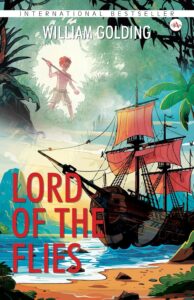
Golding, drawing upon his own experiences in the Royal Navy during World War II, sought to counter the romanticised notions of human goodness prevalent in adventure stories like R.M. Ballantyne’s “The Coral Island”. Instead, he posits that evil is not an external force but an inherent part of the human psyche, waiting for the right conditions to emerge.
Through its allegorical framework, the novel delves into profound philosophical questions concerning the nature of good and evil, the fragility of societal structures, and the loss of innocence. The island itself becomes a microcosm of the world, where the boys’ struggle to survive mirrors humanity’s perpetual battle between reason and instinct, democracy and totalitarianism.
Golding masterfully employs symbolism, from Piggy’s spectacles representing intellect and scientific endeavour, to the ‘beast’ embodying primal fear, and the titular ‘Lord of the Flies’ — a pig’s head on a stick — representing the tangible manifestation of evil and decay within the boys themselves.
“Lord of The Flies” is not merely a survival story; it is a profound psychological thriller and a dystopian classic that continues to resonate with readers, prompting critical reflection on the thin line separating order from anarchy. Its enduring power lies in its unflinching portrayal of how quickly the veneer of civilisation can crumble, revealing the savage heart that beats beneath, even in the most innocent of individuals.
Key Takeaways
The Inherent Savagery of Human Nature
Golding’s most profound and unsettling argument is that evil is not an external force or a product of societal corruption, but an intrinsic part of human nature. When the constraints of civilisation are removed, humanity’s innate capacity for cruelty, dominance, and violence quickly surfaces.
The boys’ rapid descent from organised schoolboys to a bloodthirsty tribe illustrates that the ‘beast’ they fear is, in fact, within themselves, a primal darkness that requires constant suppression by societal rules and moral frameworks. The novel suggests that civilisation is a fragile veneer, easily stripped away to reveal the underlying barbarism.
The Fragility of Civilisation and Order
The novel vividly demonstrates how quickly societal structures can crumble without adult supervision and established institutions. Ralph’s attempts to create a democratic, rule-bound society, symbolised by the conch, are ultimately overwhelmed by Jack’s appeal to primal instincts, fear, and the promise of immediate gratification (hunting, feasting).
The boys’ inability to maintain a signal fire, build shelters, or adhere to basic hygiene reflects the effort required to sustain civilisation, an effort they are unwilling or unable to make. The destruction of the conch and Piggy’s death signify the complete collapse of reason and order.
Loss of Innocence
The journey of the boys on the island is a tragic allegory for the loss of childhood innocence. They arrive as innocent schoolboys, but the harsh realities of survival, the struggle for power, and the unleashing of their darker impulses transform them into savage killers.
Characters like Simon, who represents spiritual goodness and insight, and Piggy, who embodies intellect and reason, are brutally destroyed, symbolising the obliteration of these qualities in the face of burgeoning evil. Ralph’s final tears are not just for rescue, but for the end of their innocence and the profound understanding of ‘the darkness of man’s heart’.
Power, Leadership, and Governance
Golding explores different forms of leadership and their consequences. Ralph represents democratic leadership, focused on collective good, reason, and long-term goals (rescue). Jack embodies authoritarianism, appealing to fear, immediate gratification, and the lust for power.
The boys’ gradual shift from Ralph’s democracy to Jack’s tyranny illustrates the seductive nature of absolute power and the ease with which a populace can be swayed by charismatic demagoguery, especially when fear is exploited. The novel serves as a cautionary tale about the dangers of unchecked power and the importance of ethical leadership.
Symbolism and Allegory
The novel is rich with potent symbolism. The conch represents order, democracy, and civilised discourse; its shattering signifies the end of these ideals. Piggy’s spectacles symbolise intellect, reason, and scientific advancement; their theft and destruction mark the subjugation of these qualities.
The signal fire represents hope, connection to civilisation, and the desire for rescue; its neglect and eventual destructive use highlight the boys’ regression. The ‘beast’ embodies primal fear and the inherent evil within humanity. The ‘Lord of the Flies’ (the pig’s head) is the physical manifestation of this internal evil, speaking to Simon about the darkness within. The island itself is a microcosm of the world, a paradise corrupted by human nature.
Chapter Breakdown
Chapter 1: The Sound of the Shell
The novel opens with the introduction of Ralph and Piggy, two of the first boys to emerge from the wreckage of their plane crash on a deserted tropical island. Ralph, fair-haired and athletic, quickly establishes himself as a natural leader, whilst Piggy, corpulent and asthmatic, represents intellect and reason, though he is often dismissed and ridiculed by the others. Their initial exploration leads them to discover a conch shell, which Piggy identifies as a potential tool for summoning other survivors.
Ralph blows the conch, and boys of various ages, primarily from a British public school, begin to gather. Among them is Jack Merridew, the leader of a choir, who immediately asserts his authority and attempts to claim leadership. Despite Jack’s forceful personality, the boys democratically elect Ralph as their chief, largely due to his possession of the conch and his appealing appearance. Ralph, in an attempt to appease Jack, assigns him control of the hunters.
An initial expedition comprising Ralph, Jack, and Simon explores the island, confirming its uninhabited nature and discovering its rich resources. They encounter a piglet caught in a creeper, but Jack hesitates to kill it, a moment of residual civilised inhibition. This chapter establishes the primary characters, the initial attempts at order, and the nascent tension between Ralph’s democratic leadership and Jack’s authoritarian tendencies.
Key Points
- Ralph and Piggy are introduced, establishing their contrasting personalities and roles: Ralph as the charismatic leader, Piggy as the intellectual but physically vulnerable outcast.
- The conch shell is discovered and used to call an assembly, immediately becoming a powerful symbol of order, democracy, and civilised discourse.
- Ralph is elected chief over Jack, signifying the initial preference for democratic leadership, but Jack is appeased by being given control of the choir, which he renames ‘hunters’.
- The first expedition reveals the island’s beauty and isolation, and Jack’s initial inability to kill a pig highlights his lingering connection to civilised morality.
Chapter 2: Fire on the Mountain
Ralph calls the first formal assembly using the conch, establishing rules for speaking and decision-making, symbolising the boys’ initial commitment to order and parliamentary procedure. During this meeting, a younger boy, a ‘littlun’ with a mulberry-coloured birthmark, raises the terrifying prospect of a ‘beastie’ or snake-thing on the island, igniting a pervasive fear among the group. Ralph attempts to reassure them, but the seed of fear has been sown.
Driven by the imperative for rescue, Ralph proposes building a signal fire on the mountain peak. The boys, swept up in a wave of collective enthusiasm, abandon the assembly and rush to gather wood. In their chaotic excitement, they seize Piggy’s spectacles to focus the sun’s rays and ignite the fire, demonstrating their reliance on his intellect whilst simultaneously disrespecting him. The fire quickly grows out of control, consuming a significant portion of the forest and tragically, it is implied, the ‘littlun’ with the birthmark.
This chapter marks the first significant failure of the boys’ nascent society. The uncontrolled fire symbolises their lack of foresight and discipline, whilst the implied death of the littlun underscores the dangerous consequences of their impulsiveness and the fragility of their attempts at civilisation. The fear of the beast, though initially dismissed, begins to take root, foreshadowing the island’s descent into primal terror.
Key Points
- Ralph establishes rules for the assembly, particularly regarding the conch, reinforcing its role as a symbol of order and respectful communication.
- The fear of a ‘beastie’ is introduced by a littlun, planting the seeds of primal fear and superstition that will later consume the group.
- The boys, in a fit of unorganised enthusiasm, build a massive signal fire using Piggy’s spectacles, symbolising their dependence on intellect but also their disregard for its source.
- The uncontrolled fire burns out of control, leading to the implied death of the littlun with the birthmark, highlighting the boys’ immaturity, lack of responsibility, and the destructive potential of their collective actions.
Chapter 3: Huts on the Beach
Weeks pass, and the initial enthusiasm for building a civilised society wanes. Ralph, increasingly frustrated, struggles to construct shelters on the beach with the help of only Simon, whilst the majority of the boys are distracted by play or, in Jack’s case, the relentless pursuit of hunting. Ralph articulates the practical necessity of shelter for protection against the elements and the growing fear of the ‘beastie’, but his words fall on deaf ears.
Jack, meanwhile, is consumed by his obsession with hunting. He spends his days tracking pigs, his appearance becoming more feral and his focus entirely on the primal act of the chase and kill. His inability to catch a pig despite his efforts only fuels his determination, driving him further away from the collective good and towards individual gratification. He returns from a hunt empty-handed, but his eyes gleam with a predatory intensity.
This chapter starkly contrasts Ralph’s commitment to communal welfare and long-term planning with Jack’s increasing immersion in primitive instincts. The growing chasm between them is evident in their inability to communicate effectively or understand each other’s priorities. Simon, in his quiet, introspective way, helps Ralph and then retreats to a secret, tranquil glade, symbolising his connection to nature and his spiritual insight, setting him apart from the other boys.
Key Points
- Ralph’s attempts to build shelters for the group are largely unsuccessful, highlighting the boys’ lack of discipline and their preference for immediate gratification over long-term planning.
- Jack’s obsession with hunting intensifies, marking his further descent into savagery and his prioritisation of primal urges over the collective needs of the group.
- The growing ideological divide between Ralph (civilisation, order) and Jack (savagery, instinct) becomes more pronounced, foreshadowing future conflict.
- Simon is portrayed as a solitary, intuitive figure, helping Ralph with the shelters and then retreating to a peaceful, hidden glade, symbolising his unique spiritual and natural connection.
Chapter 4: Painted Faces and Long Hair
The daily routine on the island settles into a pattern of play for the littluns, whilst Ralph struggles to maintain the signal fire and Jack continues his relentless hunting. The division between the two factions becomes more pronounced. The littluns are increasingly plagued by nightmares and fear of the ‘beastie’, their anxieties manifesting in their behaviour. Roger, a quiet but menacing older boy, begins to exhibit sadistic tendencies, throwing stones at a littlun but deliberately missing, still constrained by the remnants of civilised conditioning.
Jack’s transformation accelerates as he discovers the liberating power of face paint. Applying clay and charcoal to his face, he creates a mask that allows him to shed his inhibitions and fully embrace his primal urges. This painted face becomes a symbol of his complete break from civilisation. Under this guise, he successfully leads a hunt, brutally killing a sow, an act that solidifies his authority amongst his followers.
Tragically, this successful hunt coincides with the sighting of a ship on the horizon. The signal fire, which was Jack’s responsibility to maintain, has been allowed to go out, costing the boys their chance of rescue. Ralph’s fury at Jack’s negligence erupts into a heated confrontation, culminating in Jack striking Piggy and breaking one of his spectacle lenses. This incident underscores the growing dominance of savagery over reason and the increasing vulnerability of the civilised faction.
Key Points
- Roger’s behaviour, throwing stones at a littlun but missing, demonstrates the lingering, yet weakening, influence of societal rules and the internal struggle against innate cruelty.
- Jack’s use of face paint acts as a mask, liberating him from the shame and inhibition of civilisation, allowing him to fully embrace his savage instincts.
- Jack’s successful hunt of a sow solidifies his leadership among the hunters, but his neglect of the signal fire leads to the tragic loss of a potential rescue opportunity.
- The confrontation between Ralph and Jack, culminating in Jack striking Piggy and breaking his spectacles, symbolises the escalating conflict between order and savagery, and the vulnerability of intellect.
Chapter 5: Beast from Water
Ralph, deeply troubled by the escalating chaos and the boys’ regression, calls a serious assembly, hoping to re-establish order and address the growing fear of the ‘beast’. He attempts to remind them of their responsibilities: maintaining the signal fire, building shelters, and using the designated lavatory area. However, his efforts are met with indifference and defiance, particularly from Jack, who openly challenges Ralph’s authority and dismisses the rules.
During the assembly, the discussion inevitably turns to the ‘beast’. The littluns recount terrifying nightmares and sightings, further fuelling the collective paranoia. Piggy, ever the voice of reason, tries to rationalise the fear, insisting that there is no real beast. However, Simon offers a profound, albeit misunderstood, insight: perhaps the beast is not an external entity but something inherent within themselves, a darkness within human nature. His words are dismissed as strange and unhelpful.
The assembly descends into disarray as Jack leads many boys away, mocking Ralph’s leadership. Ralph, disheartened and feeling the weight of his responsibilities, contemplates giving up his chieftainship. Piggy and Simon, however, urge him to continue, recognising that without Ralph, their last vestiges of civilisation would crumble entirely. The chapter concludes with the boys’ fear of the beast reaching a fever pitch, symbolising the growing dominance of irrational fear and superstition over reason and order.
Key Points
- Ralph calls a crucial assembly to restore order, but his attempts to enforce rules and responsibilities are largely ignored or openly defied, particularly by Jack.
- The fear of the ‘beast’ dominates the discussion, with littluns recounting terrifying experiences, highlighting the pervasive and growing paranoia among the boys.
- Simon offers a profound, allegorical interpretation of the beast, suggesting it resides within human nature, but his insight is not understood by the others.
- The assembly dissolves into chaos, with Jack leading a significant portion of the boys away, further undermining Ralph’s authority and leaving him disillusioned, yet supported by Piggy and Simon.
Chapter 6: Beast from Air
During the night, whilst Samneric are on fire duty, a dead parachutist drifts down from the sky and lands on the mountain peak, his parachute lines snagging on rocks. In the darkness and their sleepy state, Samneric mistake the shadowy, swaying figure for the ‘beast’. Their terrified report ignites a fresh wave of panic throughout the camp, solidifying the belief in a tangible, terrifying monster on the island.
Jack seizes this opportunity to further undermine Ralph’s leadership, suggesting that the hunters should go and confront the beast. Ralph, despite his fear, recognises his duty as chief and agrees to lead an expedition to hunt the beast, accompanied by Jack and a few other older boys. They leave Piggy to look after the littluns, further marginalising him but also highlighting his practical value.
The search party explores a previously uncharted part of the island, a rocky outcrop known as Castle Rock, which Jack immediately identifies as a potential fort. Ralph, however, remains focused on the signal fire and the beast. The boys’ fear is palpable, and the chapter ends with the ominous presence of the ‘beast from air’ on the mountain, effectively preventing the maintenance of the signal fire and deepening the boys’ descent into superstition and terror.
Key Points
- A dead parachutist lands on the mountain, and Samneric mistake his swaying figure for the ‘beast’, providing tangible (though misinterpreted) evidence for the boys’ fears.
- The belief in the beast becomes widespread and deeply ingrained, further eroding the boys’ rationality and increasing their reliance on primal fear.
- Jack capitalises on the fear to assert his leadership in hunting the beast, challenging Ralph’s authority and shifting the group’s focus from rescue to survival against a perceived monster.
- Ralph leads an expedition to confront the beast, demonstrating his courage and sense of duty, but the discovery of Castle Rock by Jack foreshadows its future use as a stronghold for savagery.
Chapter 7: Shadows and Tall Trees
The expedition to hunt the beast continues, with the boys traversing increasingly dense and challenging terrain. Ralph, despite his commitment to order, finds himself drawn into the thrill of the hunt when a wild boar is sighted. He participates in the chase, even managing to wound the animal, experiencing a momentary surge of primal excitement and pride. This brief immersion in the hunters’ world reveals the latent savagery even within Ralph.
Following the unsuccessful hunt, the boys engage in a disturbing mock hunt, re-enacting the chase with Robert, one of the littluns, as the pig. The game quickly escalates into a violent frenzy, with the boys, including Ralph, losing themselves in the ritualistic beating and chanting. The scene is chilling, demonstrating how easily the line between play and genuine violence can blur, and how quickly the boys can be swept up in collective bloodlust.
Despite the unsettling incident, Ralph insists on continuing the search for the beast, driven by his sense of responsibility. Jack, ever eager to prove his bravery, volunteers to go ahead alone. Ralph and Roger eventually join him, and they reach the mountain peak. In the dim light, they perceive the shadowy, swaying figure of the dead parachutist, confirming their belief in the beast and sending them fleeing in terror. This ‘sighting’ solidifies the beast’s presence in their minds, further pushing them towards irrational fear and away from rescue.
Key Points
- Ralph, initially committed to civilisation, is momentarily drawn into the primal thrill of the hunt, revealing the latent savagery within him.
- The boys engage in a disturbing mock hunt with Robert, which quickly turns violent and ritualistic, highlighting their descent into collective bloodlust and the blurring of play and reality.
- Ralph, despite his fear, insists on continuing the search for the beast, demonstrating his sense of duty and leadership.
- The boys ‘discover’ the dead parachutist on the mountain, confirming their belief in a physical beast and solidifying their fear, effectively sealing off the mountain for a signal fire.
Chapter 8: Gift for the Darkness
The terrifying encounter with the ‘beast’ on the mountain leads to a dramatic assembly where Jack openly challenges Ralph’s leadership, accusing him of cowardice and incompetence. When the boys fail to vote Ralph out, Jack, humiliated and enraged, declares his intention to leave the group and form his own tribe, inviting anyone who wishes to hunt and have fun to join him. This marks the definitive schism between the two factions.
Ralph, devastated by Jack’s departure, attempts to rebuild morale and suggests moving the signal fire from the inaccessible mountain to the beach. Piggy, ever practical, supports this idea, and the remaining boys work together, symbolising a brief resurgence of civilised effort. However, many boys, drawn by the promise of meat and freedom from rules, gradually defect to Jack’s new tribe, which establishes its base at Castle Rock.
Jack’s tribe achieves a brutal success, hunting and killing a large sow in a savage, ritualistic manner. They impale the sow’s head on a sharpened stick as an offering to the ‘beast’. This gruesome offering, covered in flies, becomes the ‘Lord of the Flies’ – a physical manifestation of the island’s growing evil and a symbol of the boys’ internal corruption. Simon, witnessing this horrific act, has a hallucinatory conversation with the Lord of the Flies, which reveals that the beast is not an external monster but an inherent evil within humanity itself.
Key Points
- Jack openly challenges Ralph’s leadership, and upon failing to win a democratic vote, he defiantly breaks away to form his own tribe, marking the formal division of the boys.
- Ralph and the remaining boys attempt to maintain civilisation by moving the signal fire, but many are lured away by Jack’s promise of hunting and freedom from rules.
- Jack’s tribe brutally hunts and kills a sow, culminating in the impalement of its head on a stick as an offering, creating the ‘Lord of the Flies’ – a potent symbol of inherent evil.
- Simon has a hallucinatory conversation with the Lord of the Flies, which explicitly reveals that the ‘beast’ is not external but rather the savagery and evil residing within the boys themselves.
Chapter 9: A View to a Death
Simon, recovering from his hallucination and the intense heat, makes his way up the mountain, determined to confront the ‘beast’. He discovers the decaying body of the dead parachutist, realising with profound clarity that the ‘beast’ is merely a human corpse, a symbol of the adult world’s own savagery, and not a supernatural monster. He understands the true nature of the fear that has gripped the island.
Meanwhile, Jack’s tribe holds a feast, celebrating their successful hunt with roasted pig. The atmosphere is charged with primal energy, chanting, and dancing. Ralph and Piggy, drawn by the smell of the meat and the promise of food, cautiously attend the feast, hoping to reason with the boys or at least share in the bounty. However, the allure of Jack’s power and the intoxicating ritual prove too strong.
As a violent storm breaks, the boys’ frenzied dance reaches a terrifying climax. Simon, emerging from the jungle to share his revelation about the beast, is mistaken for the monster itself in the darkness and chaos. The boys, consumed by their collective hysteria and primal fear, brutally attack and kill him, beating and tearing him apart. His body is then washed out to sea, a tragic sacrifice of innocence and truth, signifying the complete triumph of savagery and irrational fear over reason and insight.
Key Points
- Simon discovers the true identity of the ‘beast’ – the dead parachutist – and understands that the real evil lies within the boys themselves, not an external monster.
- Jack’s tribe holds a celebratory feast, drawing in many boys, including Ralph and Piggy, highlighting the allure of primal satisfaction and communal ritual.
- During a violent storm and a frenzied, ritualistic dance, Simon emerges from the jungle to reveal the truth but is tragically mistaken for the beast.
- The boys, in a collective fit of hysteria and savagery, brutally murder Simon, symbolising the complete loss of innocence, the triumph of irrational fear, and the destruction of truth on the island.
Chapter 10: The Shell and the Glasses
In the aftermath of Simon’s brutal murder, Ralph, Piggy, and Samneric are the only remaining members of the original civilised group. Ralph is consumed by guilt and horror, acknowledging their complicity in Simon’s death. Piggy, in a desperate attempt to rationalise the unspeakable act, insists it was an accident, a tragic mistake, refusing to confront the full extent of their savagery. Samneric are also in denial, clinging to the idea that they left early.
Jack, now firmly established as the tyrannical chief of his tribe at Castle Rock, maintains control through fear and violence. He denies that Simon’s death was murder, claiming the beast merely disguised itself, thereby perpetuating the myth and his power. He punishes those who question him and instils a brutal discipline, further cementing his authoritarian rule. The boys are now fully immersed in a primitive, fear-driven existence.
Jack’s tribe, needing fire, launches a stealthy raid on Ralph’s camp under the cover of darkness. Their objective is not to steal the conch, which they now disregard, but to steal Piggy’s spectacles – the only means of making fire. They brutally assault Piggy and Ralph, taking the glasses and leaving them helpless. This act symbolises the complete triumph of brute force and savagery over intellect and the last remaining hope for rescue, as the signal fire can no longer be lit.
Key Points
- Ralph is deeply affected by guilt over Simon’s murder, whilst Piggy attempts to rationalise it as an accident, highlighting their differing capacities for confronting the truth of their actions.
- Jack consolidates his power as a tyrannical chief at Castle Rock, using fear and denial to maintain control and perpetuate the myth of the beast.
- Jack’s tribe raids Ralph’s camp, not for the conch, but specifically to steal Piggy’s spectacles, symbolising the complete subjugation of intellect and the loss of the means for civilisation (fire).
- The theft of the glasses leaves Ralph’s group without fire, effectively extinguishing their hope for rescue and marking a significant victory for Jack’s savage tribe.
Chapter 11: Castle Rock
Ralph, Piggy, and Samneric, now desperate and defenceless without fire, decide to confront Jack’s tribe at Castle Rock. Piggy, holding the conch, insists they must appeal to Jack’s sense of reason and justice, believing that the conch’s authority will still hold sway. Ralph, though despairing, agrees to this last, desperate attempt to restore order and retrieve Piggy’s glasses, which are essential for their survival and hope of rescue.
Upon reaching Castle Rock, they are met with hostility and a barrage of stones from Jack’s guards, particularly Roger, who has now fully embraced his sadistic nature. Ralph attempts to reason with Jack, reminding him of the importance of the signal fire and their shared humanity, but Jack is beyond reason, consumed by his lust for power and savagery. He orders his tribe to capture Samneric, forcing them to join his ranks.
In a climactic and tragic moment, Piggy, still clutching the conch and pleading for logic and order, is deliberately targeted by Roger. Roger dislodges a massive boulder, sending it crashing down onto Piggy, who falls to his death on the rocks below. The conch shatters into a thousand pieces, symbolising the complete and irreversible destruction of civilisation, reason, and democracy on the island. Ralph is left alone, utterly defeated, as Jack’s tribe celebrates their brutal victory.
Key Points
- Ralph, Piggy, and Samneric embark on a desperate mission to Castle Rock to confront Jack and retrieve Piggy’s glasses, with Piggy clinging to the belief in the conch’s power.
- They are met with extreme hostility and violence from Jack’s tribe, particularly Roger, who has fully succumbed to his innate cruelty.
- Jack captures Samneric, forcing them to join his tribe, further diminishing Ralph’s dwindling civilised faction.
- Roger deliberately kills Piggy with a boulder, simultaneously shattering the conch, symbolising the absolute triumph of savagery, the destruction of intellect, and the complete collapse of order and democracy.
Chapter 12: Cry of the Hunters
Ralph, now the sole survivor of the civilised faction, is hunted relentlessly by Jack’s tribe, who have become completely feral. He hides in the jungle, a desperate fugitive, contemplating the depths of the boys’ savagery. He encounters Samneric, who, under duress, warn him of Jack’s plans to hunt him down like a pig, revealing that Roger has sharpened a stick at both ends, implying a gruesome fate similar to the Lord of the Flies.
Jack’s tribe sets the island ablaze in a desperate attempt to smoke Ralph out of his hiding place. The entire island becomes engulfed in flames, a destructive inferno that symbolises the complete annihilation of the boys’ paradise and their own self-destruction. Ralph, fleeing for his life, is driven towards the beach, where he collapses from exhaustion and despair, expecting to be captured and killed.
However, as he falls, he looks up to see a naval officer standing over him. The officer, attracted by the massive smoke from the fire, has arrived to rescue them. The sudden appearance of an adult, a symbol of the larger civilised world, brings an abrupt end to the boys’ reign of terror. Ralph weeps, not just for the end of the nightmare, but for the loss of innocence, the darkness of man’s heart, and the death of Piggy and Simon. The officer, initially disappointed by the boys’ un-British behaviour, is left to ponder the irony of rescuing them from their own savagery, whilst his own warship represents the very adult savagery that led to their being stranded.
Key Points
- Ralph becomes a hunted animal, pursued relentlessly by Jack’s now fully savage tribe, symbolising the complete breakdown of human empathy and the triumph of primal instinct.
- Jack’s tribe sets the island on fire to flush Ralph out, leading to a massive, destructive inferno that symbolises the complete self-destruction of their island paradise.
- Ralph is rescued by a naval officer, whose arrival is ironically prompted by the very destructive fire meant to kill Ralph, bringing an abrupt end to the boys’ reign of terror.
- Ralph weeps for the loss of innocence, the darkness of man’s heart, and the deaths of Piggy and Simon, whilst the naval officer’s presence highlights the hypocrisy of adult civilisation engaged in its own global warfare.
Conclusion
William Golding’s “Lord of The Flies” remains a chillingly relevant and profoundly disturbing exploration of human nature, cementing its status as a cornerstone of 20th-century literature. Far from a simple adventure story, it is a complex allegorical novel that dissects the very foundations of civilisation and morality.
Golding’s unflinching portrayal of the boys’ descent into savagery serves as a potent counter-narrative to romanticised views of humanity, arguing instead for the pervasive presence of innate evil that lies just beneath the surface of societal order.
The novel’s enduring impact stems from its ability to provoke uncomfortable self-reflection. It forces readers to confront the uncomfortable truth that the capacity for barbarism resides within us all, and that the structures of civilisation are not merely external impositions but vital bulwarks against our darker impulses. The tragic fates of Piggy and Simon, representing intellect and spiritual insight respectively, underscore the vulnerability of these essential human qualities when confronted by unbridled primal urges and collective hysteria.
Critically acclaimed since its publication, “Lord of The Flies” is celebrated for its masterful use of symbolism, its tight narrative structure, and its profound philosophical depth. It continues to be studied globally, prompting discussions on psychology, politics, and ethics.
Golding’s final verdict is a stark warning: the ‘darkness of man’s heart’ is a universal truth, and the struggle to maintain civilisation is an ongoing, fragile endeavour, not just for marooned schoolboys, but for all of humanity, as evidenced by the very adult war raging beyond the island’s shores. It is a book that, once read, is never truly forgotten, leaving an indelible mark on the reader’s understanding of themselves and the world.