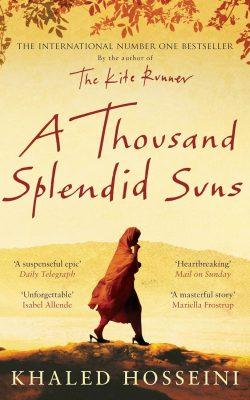
A Thousand Splendid Suns
by Khaled Hosseini
“A poignant and harrowing saga of two Afghan women, Mariam and Laila, whose lives are inextricably bound by fate, abuse, and an unbreakable bond of sisterhood amidst decades of war and oppression in Afghanistan.”
Table of Contents
ToggleOverview
Khaled Hosseini’s “A Thousand Splendid Suns” is a profoundly moving and meticulously crafted novel that delves into the lives of two women, Mariam and Laila, whose individual struggles and eventual shared destiny illuminate the brutal realities faced by women in Afghanistan over three tumultuous decades.
Spanning from the early 1960s to the post-Taliban era of the early 2000s, the narrative offers an intimate, often heartbreaking, portrait of resilience, sacrifice, and the enduring power of love and female solidarity against a backdrop of relentless political upheaval, war, and patriarchal oppression.
The novel commences by introducing Mariam, an illegitimate child, or ‘harami’, growing up in a secluded hut outside Herat, ostracised by her mother and yearning for the affection of her wealthy but distant father.
Her tragic early life sets the stage for a forced marriage to Rasheed, a shoemaker from Kabul, who is thirty years her senior.
Years later, the narrative shifts to Laila, a bright and educated young woman from Kabul, whose life is irrevocably altered by the Soviet-Afghan War and the subsequent civil strife.
Her path tragically converges with Mariam’s when she, too, is forced to marry Rasheed after a devastating bombing claims her family and leaves her pregnant with her beloved Tariq’s child.
Hosseini masterfully interweaves the personal narratives of Mariam and Laila with the broader historical tapestry of Afghanistan, from the relatively peaceful monarchy, through the Soviet invasion, the brutal civil war, the oppressive rise of the Taliban, and the eventual American intervention.
The book is not merely a story of suffering; it is a testament to the human spirit’s capacity for hope, resistance, and the formation of profound bonds in the direst of circumstances. It explores themes of identity, family, sacrifice, and the complex nature of love, particularly the transformative power of a sisterly bond forged in shared adversity, offering a powerful commentary on the socio-political landscape and the indomitable will of Afghan women.
Key Takeaways
The Enduring Power of Female Solidarity
At its heart, “A Thousand Splendid Suns” is a profound exploration of the transformative power of female relationships. Mariam and Laila, initially rivals, forge an unbreakable bond of sisterhood born out of shared suffering and mutual protection.
Their relationship transcends the traditional confines of family, becoming a source of immense strength, resilience, and love in a world designed to isolate and oppress them. This bond is ultimately the catalyst for their survival and Laila’s eventual freedom, highlighting how collective strength can emerge from individual vulnerability.
The Scars of War and Political Upheaval
Hosseini meticulously chronicles the devastating impact of Afghanistan’s turbulent history on its people, particularly women. From the Soviet invasion to the civil war and the brutal reign of the Taliban, the narrative illustrates how political instability and conflict strip individuals of their rights, homes, and dignity.
The constant threat of violence, the destruction of infrastructure, and the erosion of societal norms are not merely background elements but active forces shaping the characters’ destinies, demonstrating the long-lasting psychological and physical scars left by prolonged conflict.
Resilience and the Search for Identity
Both Mariam and Laila, despite vastly different upbringings, are forced to navigate a world that seeks to diminish their worth and agency. Mariam, an ‘harami’, struggles with a lifelong sense of illegitimacy, whilst Laila fights to maintain her intellectual and personal freedom.
Their journeys are a testament to the human spirit’s capacity for resilience, finding strength in adversity, and ultimately forging their own identities and purpose, even when societal structures conspire against them. Their stories underscore the inherent human desire for dignity and self-determination.
The Complexities of Love and Sacrifice
The novel explores various forms of love: the unrequited love of Mariam for her father, the passionate young love between Laila and Tariq, the maternal love for their children, and the profound, sacrificial love between Mariam and Laila.
Mariam’s ultimate act of self-sacrifice for Laila and her children is the emotional core of the book, demonstrating that love can manifest not just in tenderness, but in fierce protection and the willingness to give everything for another’s well-being. This sacrifice elevates the narrative beyond mere tragedy to a powerful affirmation of human connection.
Hope Amidst Despair
Despite the relentless suffering depicted, “A Thousand Splendid Suns” is ultimately a story imbued with hope. Laila’s return to Afghanistan, her work at the orphanage, and the naming of her new daughter Mariam symbolise a commitment to rebuilding and remembering.
It suggests that even after decades of war and oppression, the spirit of Afghanistan and its people endures, holding the promise of renewal and a future where the ‘thousand splendid suns’ of Kabul might once again shine. This enduring optimism is a powerful message of human perseverance.
Chapter Breakdown
Chapter 1: Mariam’s Solitary Dawn
The novel opens in the early 1960s, introducing Mariam, a ‘harami’ (bastard) living with her bitter mother, Nana, in a remote shack outside Herat. Mariam’s childhood is marked by isolation, Nana’s constant resentment, and the weekly visits from her wealthy father, Jalil, who represents a tantalising, yet ultimately unfulfilled, promise of a better life. Despite Nana’s warnings, Mariam’s longing for her father’s acceptance leads her to defy her mother and seek him out on her fifteenth birthday, an act that precipitates Nana’s suicide and shatters Mariam’s fragile world.
Orphaned and alone, Mariam is swiftly married off by Jalil’s wives to Rasheed, a much older shoemaker from Kabul. This forced union transports her from the rural simplicity of Herat to the bustling, yet alien, city of Kabul, where she endures years of loneliness, Rasheed’s increasing cruelty, and the profound sorrow of multiple miscarriages. Her inability to bear a son solidifies her status as a disappointment in Rasheed’s eyes, leading to escalating physical and emotional abuse, and leaving her in a state of quiet, desperate resignation.
Mariam’s early life is a stark portrayal of the limited agency afforded to women in traditional Afghan society, particularly those of her unfortunate birth. Her experiences establish a foundational understanding of the patriarchal structures and societal expectations that will continue to shape the lives of women throughout the narrative, highlighting the devastating consequences of a lack of choice and the crushing weight of societal stigma.
Key Points
- Mariam’s childhood as an illegitimate child, ‘harami’, in rural Herat, marked by her mother Nana’s bitterness and her father Jalil’s distant affection.
- Her defiance in seeking out Jalil on her fifteenth birthday leads directly to Nana’s suicide, leaving Mariam orphaned and vulnerable.
- Mariam is forced into an arranged marriage with Rasheed, a much older man from Kabul, where she endures years of abuse and the heartbreak of multiple miscarriages, solidifying her sense of worthlessness in his eyes.
Chapter 2: Laila’s Ascendant Star
Part Two shifts focus to Laila, a bright, educated, and beautiful young girl growing up in Kabul in the 1970s and 80s. Her life stands in stark contrast to Mariam’s, as she benefits from the progressive ideals of her intellectual father, Babi, and the fierce, albeit often distracted, love of her mother, Fariba. Laila’s world is one of books, learning, and the cherished companionship of her childhood friend and eventual love interest, Tariq, who lost a leg to a landmine but remains fiercely independent and protective.
The escalating Soviet-Afghan War and subsequent civil strife gradually erode the stability of Laila’s life. Her two older brothers are killed fighting the Soviets, plunging Fariba into a deep depression. As the war intensifies and rockets rain down on Kabul, Babi, who dreams of a peaceful, educated Afghanistan, plans to move the family to Pakistan. However, a devastating rocket attack on their home tragically kills her parents and leaves Laila severely injured.
Rasheed, ever the opportunist, rescues Laila from the rubble, nurses her back to health, and manipulates her into marrying him by falsely claiming Tariq has died. Pregnant with Tariq’s child, Laila sees no other option for survival and the protection of her unborn baby. This forced marriage marks the tragic convergence of Laila’s and Mariam’s lives under Rasheed’s tyrannical roof, setting the stage for their complex and ultimately transformative relationship.
Key Points
- Laila’s upbringing in Kabul is characterised by education, the love of her progressive father Babi, and her deep bond with her childhood friend and love, Tariq.
- The escalating Soviet-Afghan War and civil conflict devastate Laila’s family, culminating in a rocket attack that kills her parents and leaves her injured.
- Rasheed manipulates Laila into marrying him by fabricating Tariq’s death, forcing her into a shared existence with Mariam under his abusive control, whilst secretly pregnant with Tariq’s child.
Chapter 3: Two Lives Intertwined
The third part of the novel details the initial antagonism and eventual profound bond between Mariam and Laila under Rasheed’s oppressive rule. Initially, Mariam views Laila as an unwelcome intruder, a younger, prettier rival for Rasheed’s fleeting attention. Laila, in turn, resents Mariam’s subservience. However, as Rasheed’s abuse intensifies, particularly after the birth of Laila’s daughter, Aziza, whom he despises for not being a boy, the two women begin to find solace and strength in each other’s company.
Their shared suffering and the common enemy in Rasheed forge an unbreakable sisterhood. They conspire to escape Kabul with Aziza, but their attempt is thwarted, leading to a brutal beating from Rasheed and further isolation. The arrival of the Taliban brings even harsher restrictions on women, stripping them of their rights to education, work, and even independent movement, exacerbating their already dire circumstances. Rasheed, initially welcoming the Taliban’s strictures, uses them to further control his wives.
Laila later gives birth to a son, Zalmai, who becomes Rasheed’s favourite, further highlighting his misogyny and the precarious position of women. Despite the constant threat and violence, Mariam and Laila’s bond deepens, becoming the central pillar of their survival. They learn to rely on each other for emotional support, protection, and the shared hope for a future free from Rasheed’s tyranny, demonstrating the extraordinary resilience of female solidarity.
Key Points
- Initially antagonistic, Mariam and Laila’s relationship evolves into a profound sisterhood forged by their shared suffering under Rasheed’s escalating abuse, particularly after the birth of Laila’s daughter, Aziza.
- Their failed escape attempt results in a severe beating from Rasheed, further cementing their reliance on each other and highlighting their entrapment.
- The rise of the Taliban imposes draconian laws on women, intensifying their oppression and making their lives even more perilous, yet strengthening the bond between Mariam and Laila as they navigate these new dangers together.
Chapter 4: Sacrifice, Return, and Renewal
The final part of the novel brings the narrative to its harrowing climax and hopeful resolution. Tariq, alive and well, unexpectedly reappears, revealing Rasheed’s deceit. This reunion ignites Rasheed’s fury, leading to a violent attack on Laila that Mariam cannot bear to witness. In a moment of desperate defence, Mariam strikes Rasheed with a shovel, killing him. This act of ultimate sacrifice ensures Laila and the children’s freedom, but at the cost of Mariam’s own life, as she willingly surrenders to the authorities and is publicly executed by the Taliban.
Laila, Tariq, Aziza, and Zalmai escape to Pakistan, where they build a new life together, finding a measure of peace and stability. However, Laila is haunted by Mariam’s sacrifice and the state of her homeland. After the fall of the Taliban, Laila decides to return to Afghanistan, driven by a desire to honour Mariam’s memory and contribute to the rebuilding of her country. She visits Mariam’s childhood home in Herat, finding a box of her father Jalil’s belongings, which includes a letter of apology and a small inheritance, offering Mariam a posthumous sense of belonging and validation.
Laila returns to Kabul and dedicates herself to working at an orphanage, embodying the spirit of hope and resilience that defines the novel. She becomes pregnant again, choosing to name her new daughter Mariam, ensuring her legacy lives on. The conclusion is a powerful testament to the enduring human spirit, the cyclical nature of history, and the profound impact of individual acts of courage and love, suggesting that even amidst immense suffering, there is always the possibility of renewal and a brighter future for Afghanistan.
Key Points
- Tariq’s unexpected return exposes Rasheed’s lies, leading to a violent confrontation where Mariam kills Rasheed in defence of Laila, ultimately sacrificing herself for Laila and the children’s freedom.
- Laila, Tariq, Aziza, and Zalmai escape to Pakistan, where they begin to rebuild their lives, but Laila remains deeply affected by Mariam’s sacrifice and the plight of Afghanistan.
- Laila returns to Afghanistan after the Taliban’s fall, finds closure regarding Mariam’s past, and dedicates herself to working at an orphanage, embodying hope for the future and naming her new daughter Mariam in honour of her beloved friend.
Conclusion
Khaled Hosseini’s “A Thousand Splendid Suns” stands as a monumental achievement in contemporary literature, a searing and unforgettable narrative that transcends its specific setting to speak to universal themes of human endurance, love, and the devastating impact of conflict.
As an elite literary critic, one cannot help but be profoundly moved by Hosseini’s masterful storytelling, his ability to craft characters of such depth and authenticity that their struggles feel intimately personal, whilst simultaneously illuminating the broader socio-political landscape of Afghanistan.
The novel’s critical reception has been overwhelmingly positive, lauded for its powerful emotional resonance, its unflinching portrayal of the plight of Afghan women, and its elegant prose.
Hosseini’s decision to centre the narrative on female voices provides a crucial counter-narrative to often male-dominated accounts of war, offering a vital perspective on the domestic and personal costs of conflict. The British English rendering of the text further enhances its accessibility and literary gravitas for a global audience, ensuring its place as a significant work.
Ultimately, “A Thousand Splendid Suns” is more than just a story; it is a profound act of empathy, a call to recognise the dignity and resilience of those who endure unimaginable hardship.
It is a book that educates, devastates, and inspires in equal measure, leaving an indelible mark on the reader’s consciousness. Its exploration of female solidarity, sacrifice, and the enduring human spirit amidst the ruins of war makes it an essential and timeless piece of literature, a truly splendid and necessary read for anyone seeking to understand the complexities of the human heart and the world we inhabit.