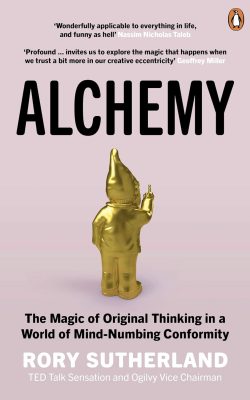
Alchemy: The Dark Art and Curious Science of Creating Magic in Brands, Business, and Life
by Rory Sutherland
“A provocative exploration of how counter-intuitive, ‘illogical’ solutions, rooted in human psychology and perception, often outperform purely rational, data-driven approaches in business and life.”
Table of Contents
ToggleOverview
Rory Sutherland’s “Alchemy” is a profound and often hilarious manifesto against the tyranny of logic and data in problem-solving.
As Vice Chairman of Ogilvy UK, Sutherland draws upon decades of experience in advertising and behavioral science to argue that the most effective solutions are frequently those that defy conventional wisdom, appearing irrational or even wasteful to the purely logical mind.
He posits that while logic excels at optimizing existing systems, it often fails to discover truly novel or transformative solutions because it overlooks the complex, often subconscious, drivers of human behaviour.
Sutherland champions an “alchemical” approach, one that embraces the power of perception, context, and psychological biases to create disproportionate value and solve intractable problems.
The book challenges the prevailing belief that all good ideas must be quantifiable, predictable, or derived from big data. Instead, Sutherland advocates for a deeper understanding of human nature, suggesting that many of our ‘irrational’ behaviors are, in fact, deeply rational from an evolutionary or psychological perspective. He argues that by understanding these underlying mechanisms, we can craft solutions that resonate more powerfully with people, leading to outcomes that seem like magic.
“Alchemy” is not merely a critique; it’s a practical guide to thinking differently. It encourages readers to question assumptions, embrace experimentation, and recognize the strategic value in things that appear inefficient or illogical. Sutherland’s work is a vital counterpoint to the increasingly data-obsessed world, reminding us that the human element, with all its quirks and complexities, remains the ultimate arbiter of value and success.
Key Takeaways
The Tyranny of Logic vs. The Power of Perception
Sutherland argues that modern society is overly reliant on logic and data, which are excellent for optimization but poor for innovation, especially when human behavior is involved. He champions ‘alchemical’ thinking, which prioritizes understanding and manipulating human perception, context, and psychological biases to create disproportionate value. The core idea is that people don’t experience objective reality, but a subjective one, and influencing this perception is often more effective than changing objective facts.
Behavioural Economics as a Strategic Tool
The book extensively uses insights from behavioral economics to explain why people act ‘irrationally’ and how these predictable biases can be leveraged. Rather than fighting human nature, Sutherland suggests designing solutions that work *with* our cognitive quirks. Understanding concepts like loss aversion, framing, and signaling allows for the creation of ‘nudges’ and interventions that are far more effective than purely rational appeals, leading to outcomes that feel like magic.
The Strategic Value of 'Waste' and Counter-Intuitive Solutions
Perhaps the most counter-intuitive takeaway is that what appears to be inefficient or wasteful from a logical standpoint can be a highly strategic investment. Sutherland explains the concept of ‘signaling,’ where costly actions (like luxury goods or expensive advertising) communicate valuable, otherwise unprovable, information about quality, commitment, or trustworthiness. This challenges the relentless pursuit of efficiency, suggesting that sometimes, doing things in a less ‘optimal’ way can yield superior results by tapping into deeper psychological drivers and building trust.
Embrace Experimentation and Serendipity
Sutherland advocates for a more experimental, iterative, and evolutionary approach to problem-solving. He argues that the world is too complex for purely predictive models, and true innovation often emerges from serendipity, trial-and-error, and a willingness to explore seemingly irrational avenues. By fostering a culture of ‘test and learn’ and embracing uncertainty, businesses and individuals can discover alchemical breakthroughs that rigid, logical planning would never permit, allowing for emergent solutions to complex human problems.
Chapter Breakdown
Chapter 1: The Illusion of Logic and the Alchemist’s Mindset
Sutherland opens by establishing the central conflict of the book: the pervasive overreliance on logic and data in modern decision-making, often at the expense of more effective, albeit less obvious, solutions. He argues that while logic is excellent for optimizing existing systems and solving well-defined problems, it is inherently limited when dealing with human behavior, which is frequently driven by subconscious desires, social signals, and emotional responses rather than pure rationality.
He introduces the concept of “alchemy” as the art of creating value through non-obvious means, often by changing perception rather than objective reality. This involves understanding the ‘why’ behind human actions, which data alone cannot provide. Sutherland suggests that many of the most successful innovations throughout history have been alchemical, leveraging psychological insights to create disproportionate impact, even if they appear inefficient or illogical on the surface. He challenges the reader to adopt a mindset that questions assumptions and looks beyond the immediately quantifiable.
Key Points
- Logic is a powerful tool for optimization but often fails to discover truly novel solutions because it overlooks the complexities of human psychology.
- “Alchemy” is defined as the art of creating value through non-obvious, often counter-intuitive means, primarily by altering perception rather than objective reality.
- The book advocates for a shift from a purely rational, data-driven approach to one that embraces psychological insights and the ‘dark arts’ of human behavior.
Chapter 2: The Power of Perception and Context
This section delves into how context, framing, and perception fundamentally alter the value and experience of products, services, and ideas. Sutherland illustrates that human beings do not experience objective reality; instead, they experience a subjective reality shaped by their beliefs, expectations, and the surrounding environment. A product’s perceived value can be dramatically increased or decreased not by changing its physical attributes, but by altering how it is presented or understood.
He provides numerous examples, from the perceived taste of wine influenced by its label to the willingness to pay more for a coffee served in a pleasant café versus a sterile office. The core argument is that marketing and branding are not merely about informing, but about creating a desirable context and shaping perception. This ‘psychological value’ often outweighs ‘functional value’ in driving consumer choice, highlighting the limitations of purely functional design or engineering without considering the human element.
Key Points
- Human perception is subjective and heavily influenced by context, framing, and expectations, making objective reality less relevant than perceived reality.
- The perceived value of a product or service can be significantly altered by its presentation, branding, and the environment in which it is encountered, often without changing its inherent functional attributes.
- Understanding and manipulating psychological context is a powerful alchemical tool for creating disproportionate value and influencing behaviour.
Chapter 3: Behavioral Economics in Action: Understanding Human Irrationality
Sutherland explores the rich landscape of behavioral economics, demonstrating how cognitive biases and heuristics consistently lead humans to make decisions that defy classical economic rationality. He argues that these ‘irrationalities’ are not flaws but often adaptive mechanisms rooted in evolutionary psychology, and understanding them is key to alchemical problem-solving. Concepts like loss aversion, anchoring, framing effects, and the sunk cost fallacy are explained with vivid examples.
He emphasizes that these biases are predictable and can be leveraged to design more effective interventions, products, and communications. Instead of trying to force people to be rational, the alchemist works with human nature, designing solutions that align with existing psychological tendencies. This often involves ‘nudges’ that subtly guide behavior without restricting choice, proving far more effective than direct logical appeals or mandates.
Key Points
- Human decision-making is consistently influenced by predictable cognitive biases and heuristics, which often lead to ‘irrational’ choices from a purely logical perspective.
- These biases are not defects but often adaptive evolutionary traits, and understanding them is crucial for designing effective solutions that resonate with human nature.
- Behavioral economics provides a toolkit for ‘nudging’ behavior by aligning solutions with psychological tendencies, proving more effective than trying to enforce pure rationality.
Chapter 4: The Strategic Value of 'Waste' and Counter-Intuitive Solutions
One of Sutherland’s most provocative arguments is that what appears to be ‘waste’ or inefficiency from a purely logical standpoint can often be a highly effective strategic investment. He introduces the concept of ‘signaling’ – where seemingly extravagant or illogical actions serve to communicate valuable information, such as quality, commitment, or trustworthiness, in a way that cheaper, more efficient alternatives cannot.
Examples range from the elaborate tail of a peacock (a signal of genetic fitness) to expensive advertising campaigns (a signal of confidence and commitment to a brand). These ‘wasted’ resources create psychological value, trust, and desire that cannot be achieved through purely functional means. This section challenges the relentless pursuit of efficiency and cost-cutting, arguing that sometimes, spending more or doing things in a less ‘optimal’ way can yield superior results by tapping into deeper psychological drivers.
Key Points
- Seemingly ‘wasteful’ expenditures or inefficiencies can serve as powerful signals, communicating quality, commitment, or trustworthiness in ways that purely logical approaches cannot.
- The ‘peacock’ principle illustrates how costly signals, though inefficient in resource terms, are highly effective in conveying valuable, otherwise unprovable, information.
- Challenging the dogma of efficiency, Sutherland argues that strategic ‘waste’ can create disproportionate psychological value and lead to superior outcomes.
Chapter 5: Marketing, Magic, and the Art of Desire Creation
This chapter focuses on the alchemical nature of marketing and advertising, positioning them not as mere information dissemination but as powerful tools for creating desire, shaping perception, and building brands that transcend their functional attributes. Sutherland argues that the best advertising doesn’t just tell you what a product does; it tells you what it *means* and how it will make you *feel*.
He explores how advertising taps into deeper human needs for status, belonging, identity, and self-expression, often through indirect and emotional appeals. The ‘magic’ of marketing lies in its ability to transform a commodity into something desirable, to imbue products with meaning, and to create a narrative that resonates with consumers on a subconscious level. This process is inherently alchemical, turning the mundane into the magical through the artful manipulation of perception and psychological triggers.
Key Points
- Marketing and advertising are alchemical arts that create desire and shape perception, going beyond mere information to imbue products with meaning and emotional resonance.
- Effective advertising taps into deeper human psychological needs such as status, identity, and belonging, rather than solely focusing on functional benefits.
- The ‘magic’ of branding lies in its ability to transform commodities into desirable objects by crafting compelling narratives and leveraging psychological triggers.
Chapter 6: Embracing Experimentation, Evolution, and the Unpredictable
Sutherland advocates for a more experimental, iterative, and evolutionary approach to problem-solving, contrasting it with rigid, top-down planning based solely on logical deduction. He argues that many of the best solutions are discovered through serendipity, trial-and-error, and a willingness to explore seemingly irrational avenues. The world is too complex and human behavior too nuanced for purely predictive models to consistently yield optimal results.
He encourages a culture of ‘test and learn,’ where small, low-cost experiments are conducted to uncover unexpected insights. This approach acknowledges that true innovation often emerges from the edges, from playful exploration, and from observing what actually works in the real world, rather than what logic dictates *should* work. By embracing uncertainty and allowing for emergent solutions, businesses and individuals can unlock alchemical breakthroughs that rigid planning would never permit.
Key Points
- The most effective solutions often arise from experimentation, serendipity, and a willingness to explore seemingly irrational or unpredictable avenues, rather than rigid logical planning.
- A ‘test and learn’ culture, involving small, low-cost experiments, is crucial for uncovering unexpected insights and adapting to the complexities of human behavior.
- Embracing uncertainty and allowing for emergent solutions through iterative processes is key to achieving alchemical breakthroughs that purely predictive models often miss.
Conclusion
Rory Sutherland’s “Alchemy” stands as a vital and refreshing counterpoint to the prevailing dogma of data-driven rationality. It is a deeply insightful and often humorous exploration of how the most profound and effective solutions often lie beyond the realm of pure logic, residing instead in the nuanced, complex, and often ‘irrational’ landscape of human psychology.
Sutherland, with his unique blend of advertising acumen and behavioral science expertise, masterfully articulates why understanding perception, context, and our inherent biases is not merely an interesting academic pursuit but a critical strategic imperative for anyone seeking to innovate, persuade, or simply understand the world better. The book’s strength lies in its ability to make complex psychological concepts accessible and actionable, illustrating them with a wealth of engaging anecdotes and real-world examples.
As an elite literary critic, I find “Alchemy” to be a triumph of intellectual provocation. It doesn’t just offer new answers; it compels readers to ask better questions, to challenge their assumptions, and to embrace a more holistic, human-centric approach to problem-solving. Its impact is profound, urging a re-evaluation of what constitutes ‘value’ and how it is truly created in a world increasingly dominated by algorithms. “Alchemy” is not just a book; it’s a paradigm shift, an essential read for anyone who believes that the greatest magic often lies in the unseen and the unexpected.