
Freedom At Midnight
By Dominique Lapierre & Larry Collins
“A gripping, meticulously researched narrative that plunges into the tumultuous final months of British rule in India, chronicling the birth of two nations amidst unprecedented chaos, hope, and human tragedy.”
Table of Contents
ToggleOverview
Dominique Lapierre and Larry Collins’ “Freedom At Midnight” is a monumental work of narrative history, meticulously reconstructing the dramatic and often horrifying events surrounding India’s independence from British rule and its subsequent partition in 1947.
The book is not merely a dry recounting of political negotiations but a vivid, almost cinematic portrayal of a pivotal moment in human history, told through the eyes of both the powerful and the powerless.
Set against the backdrop of a war-weary Britain eager to shed its imperial burden and a subcontinent simmering with nationalist fervor and communal tension, the narrative opens with the arrival of Lord Louis Mountbatten, the last Viceroy, tasked with the seemingly impossible mission of transferring power within a brutally tight deadline.
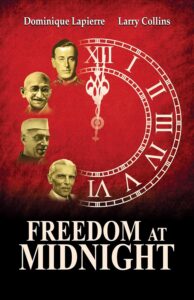
The authors masterfully weave together high-level political intrigue involving figures like Mahatma Gandhi, Jawaharlal Nehru, and Muhammad Ali Jinnah, with the personal stories and experiences of ordinary Indians and Britons caught in the maelstrom.
The core of the book explores the agonizing choices made by leaders under immense pressure, the tragic inevitability of partition as communal violence escalated, and the catastrophic human cost of drawing arbitrary lines on a map. Lapierre and Collins delve into the psychological landscapes of these historical figures, revealing their motivations, their triumphs, and their profound failures. They expose the complexities of decolonization, where the promise of freedom was inextricably linked to an unimaginable bloodbath and mass displacement.
“Freedom At Midnight” stands as a testament to the power of journalistic history, combining exhaustive research—including interviews with key participants and access to previously unpublished documents—with a compelling, novelistic style. It captures the euphoria of independence alongside the terror of communal riots, the idealism of nation-building alongside the brutal realities of sectarian hatred, offering a comprehensive and deeply human perspective on one of the 20th century’s most significant and tragic events.
Key Takeaways
The Human Cost of Political Decisions
The book vividly illustrates how high-level political decisions, even those made with the best intentions, can have catastrophic consequences for ordinary people. The partition of India, a geopolitical solution to an intractable problem, resulted in the largest mass migration in human history, accompanied by unimaginable violence, displacement, and loss of life. It underscores the profound responsibility of leadership and the devastating impact when political expediency overrides human empathy.
The Fragility of Peace and the Power of Communal Hatred
Lapierre and Collins demonstrate how quickly centuries of coexistence can unravel when fueled by political opportunism, fear, and religious extremism. The narrative serves as a stark warning about the ease with which communal tensions can be ignited and the immense difficulty of extinguishing them once they take hold. It highlights the inherent dangers of identity politics and the devastating potential of sectarian violence when institutions fail to maintain order.
The Complexities of Decolonization
The book reveals that decolonization is rarely a clean or straightforward process. While it brought freedom from imperial rule, it also unleashed pre-existing tensions and created new ones, leaving behind a legacy of unresolved conflicts and deep-seated grievances. The British withdrawal, though inevitable, was rushed and poorly executed, contributing significantly to the ensuing chaos and highlighting the challenges inherent in dismantling a vast empire.
The Role of Leadership in Crisis
The book offers a nuanced portrayal of key leaders like Mountbatten, Gandhi, Nehru, and Jinnah, showcasing their strengths, weaknesses, and the immense pressures they faced. It explores how individual personalities, decisions, and intransigence shaped the course of history, for better or worse. Gandhi’s moral leadership stands in contrast to Jinnah’s unyielding political will, while Mountbatten’s decisive, yet sometimes hasty, actions played a critical role in accelerating the timeline and shaping the outcome.
Chapter Breakdown
Chapter 1: The Last Viceroy's Impossible Mission
The book opens by setting the stage in early 1947, depicting a Britain exhausted by World War II and financially unable to sustain its vast Indian Empire. The Labour government, led by Prime Minister Clement Attlee, makes the momentous decision to grant India independence by June 1948, appointing Lord Louis Mountbatten, a charismatic and ambitious relative of the Royal Family, as the last Viceroy. Mountbatten arrives in India with his dynamic wife, Edwina, facing a subcontinent on the brink of chaos, deeply divided by religious and political factions.
Lapierre and Collins vividly portray Mountbatten’s initial assessment of the situation: a vast, complex land with a population of hundreds of millions, deeply entrenched communal hatreds between Hindus and Muslims, and a political landscape dominated by the Indian National Congress (led by Gandhi and Nehru) and the Muslim League (led by Jinnah). His mandate is clear but seemingly impossible: to transfer power smoothly and preserve a united India, if possible, within an incredibly tight timeframe. The authors highlight Mountbatten’s initial optimism and his gradual realization of the insurmountable obstacles.
Key Points
- Britain’s post-WWII exhaustion and decision to grant India independence by June 1948.
- Lord Louis Mountbatten’s appointment as the last Viceroy, tasked with an accelerated transfer of power.
- The initial state of India: a vast, divided nation on the verge of communal strife, with major political players like Gandhi, Nehru, and Jinnah holding irreconcilable positions.
Chapter 2: The Irreconcilable Visions: Gandhi, Nehru, Jinnah
This section delves into the personalities and political philosophies of the three towering figures who would shape India’s destiny. Mahatma Gandhi, the spiritual father of the independence movement, is depicted as a deeply revered but increasingly isolated figure, advocating for a united India based on non-violence and communal harmony, even as the ground reality slipped away from his control. His moral authority was immense, but his political influence waned in the face of escalating sectarian demands.
Jawaharlal Nehru, Gandhi’s chosen political heir, emerges as a pragmatic statesman, a secularist and socialist who envisioned a modern, industrialized, and united India. He was torn between his loyalty to Gandhi’s ideals and the harsh political realities. Muhammad Ali Jinnah, the enigmatic and unyielding leader of the Muslim League, is presented as the architect of Pakistan, driven by a deep-seated fear for the future of Muslims in a Hindu-majority India. His demand for a separate Muslim state, initially dismissed as a bargaining chip, became an unshakeable resolve, making any compromise for a united India impossible.
Key Points
- Mahatma Gandhi’s diminishing political influence despite his moral authority, as he clung to the ideal of a united, non-violent India.
- Jawaharlal Nehru’s pragmatic leadership, balancing secular ideals with the political necessity of compromise.
- Muhammad Ali Jinnah’s unwavering demand for a separate Muslim state (Pakistan), driven by fears of Hindu domination and his determination to secure a homeland for Muslims.
Chapter 3: The Mountbatten Plan: Partition Becomes Inevitable
Mountbatten, after extensive negotiations and a whirlwind tour of the subcontinent, quickly realizes that a united India is no longer a viable option. The chasm between the Congress and the Muslim League, particularly Jinnah’s intransigence, proves too wide to bridge. The book details the agonizing process by which Mountbatten, initially committed to unity, is forced to accept the inevitability of partition as the only way to avoid a full-scale civil war.
The narrative highlights the immense pressure on Mountbatten to accelerate the timeline, moving the date of independence from June 1948 to August 15, 1947. This drastic acceleration, while intended to limit further violence, ultimately contributed to the chaos that followed. The decision to partition is presented not as a triumph, but as a desperate measure, a bitter pill swallowed by all parties, with Mountbatten playing a crucial, if controversial, role in pushing it through.
Key Points
- Mountbatten’s realization that a united India was impossible due to the irreconcilable demands of the Congress and the Muslim League.
- The decision to partition India, presented as a desperate measure to avert widespread civil war.
- The acceleration of the independence date to August 15, 1947, a decision that intensified the subsequent chaos and violence.
Chapter 4: Drawing the Lines: The Radcliffe Award
With partition agreed upon, the monumental and unenviable task of drawing the new borders falls to Sir Cyril Radcliffe, a British lawyer with no prior experience in India. The book vividly describes Radcliffe’s isolated and hurried process, given just five weeks to demarcate the boundaries of Punjab and Bengal, two provinces with mixed populations and complex geographical and economic interdependencies. He worked in secrecy, with inadequate maps and limited understanding of local realities, under immense pressure to deliver the lines before independence.
The authors emphasize the arbitrary nature of the Radcliffe Line, which cut through villages, farms, and even homes, separating families and communities that had lived together for centuries. The delay in publicly announcing the exact boundaries until after independence day further exacerbated the confusion and violence, leaving millions uncertain of their nationality and future. This section underscores the profound human impact of abstract political decisions made by distant authorities.
Key Points
- Sir Cyril Radcliffe’s hurried and isolated task of drawing the borders for Punjab and Bengal with minimal local knowledge.
- The arbitrary and often illogical nature of the Radcliffe Line, which divided communities and caused immense confusion.
- The delayed announcement of the final borders until after independence, contributing significantly to the ensuing chaos and violence.
Chapter 5: The Countdown to Freedom: Hope and Rising Terror
As August 15, 1947, approaches, the atmosphere across India is a volatile mix of euphoria and dread. The book captures the widespread excitement and anticipation for independence, with preparations for celebrations underway in Delhi and other major cities. However, beneath this veneer of hope, a terrifying undercurrent of communal violence begins to swell, particularly in the border regions of Punjab and Bengal.
Lapierre and Collins detail the breakdown of law and order, the inadequacy of the remaining British forces, and the unpreparedness of the nascent Indian and Pakistani administrations to handle the impending catastrophe. The narrative intersperses accounts of official preparations for the transfer of power with chilling reports of localized massacres, arson, and forced conversions, painting a grim picture of a society teetering on the edge of anarchy. The dream of freedom was rapidly turning into a nightmare for millions.
Key Points
- The dual atmosphere of euphoria for independence and growing dread due to escalating communal violence.
- The breakdown of law and order and the inability of existing forces to contain the rising sectarian conflict.
- The stark contrast between official preparations for independence celebrations and the grim reality of massacres and chaos in the border regions.
Chapter 6: Midnight’s Children: Birth of Two Nations, Dawn of Horror
The stroke of midnight on August 14-15, 1947, marks the official transfer of power. The book vividly describes the joyous celebrations in Delhi, with Jawaharlal Nehru’s iconic ‘Tryst with Destiny’ speech echoing through the Constituent Assembly. India is born, and Pakistan simultaneously comes into existence. However, this moment of triumph is immediately overshadowed by the unleashing of unprecedented violence across the newly drawn borders.
The authors meticulously document the immediate aftermath: the mass killings, rapes, and abductions that erupt on an unimaginable scale. Trains carrying refugees become ‘ghost trains’ filled with corpses, and roads are choked with millions of displaced people. This chapter starkly contrasts the idealism of the political leaders with the brutal reality faced by ordinary citizens, whose lives are irrevocably shattered by the partition. The dream of freedom for some became a living hell for millions of others.
Key Points
- The joyous celebrations in Delhi marking India’s independence and Nehru’s ‘Tryst with Destiny’ speech.
- The simultaneous birth of Pakistan and the immediate eruption of widespread, horrific communal violence.
- The devastating human cost: mass killings, rapes, and the transformation of refugee trains into ‘ghost trains’ filled with victims.
Chapter 7: The Great Exodus: A Continent on the Move
This chapter focuses on the largest mass migration in human history, as an estimated 12 to 15 million people—Hindus and Sikhs from Pakistan, and Muslims from India—uproot their lives to cross the newly established borders. The book provides harrowing accounts of these journeys, undertaken on foot, in bullock carts, or on overcrowded trains, often under the constant threat of attack from hostile mobs.
Lapierre and Collins paint a visceral picture of the suffering: starvation, disease, exposure, and the constant fear of violence. They detail the breakdown of infrastructure, the overwhelmed relief efforts, and the sheer scale of human misery. The narrative emphasizes the personal stories of loss, resilience, and unimaginable trauma, illustrating how the political decision of partition translated into an existential crisis for millions of individuals and families, forever altering the demographic and social fabric of the subcontinent.
Key Points
- The unprecedented scale of the mass migration, involving 12-15 million people crossing the new borders.
- Harrowing accounts of refugee journeys marked by starvation, disease, exposure, and constant threat of violence.
- The profound personal and societal trauma of displacement, loss, and the breakdown of social order.
Chapter 8: Gandhi's Last Fast and Assassination
Amidst the widespread violence and despair, Mahatma Gandhi embarks on his final fast unto death, a desperate plea for communal harmony and peace. The book portrays Gandhi as a figure of immense moral courage, using his ultimate spiritual weapon to shame political leaders and ordinary citizens into ending the bloodshed. His fast has a profound impact, temporarily quelling some of the violence and bringing leaders to the negotiating table.
However, Gandhi’s efforts to foster unity are met with resentment by Hindu extremists who blame him for the partition and for ‘appeasing’ Muslims. The narrative culminates in the tragic assassination of Gandhi by Nathuram Godse on January 30, 1948. This event, meticulously recounted, marks a somber end to the initial period of independence, symbolizing the death of an ideal and the profound challenges that lay ahead for the newly formed nations. His death, ironically, brought a temporary halt to the violence he had fought so hard to stop.
Key Points
- Mahatma Gandhi’s final fast unto death, a desperate moral appeal for communal harmony amidst escalating violence.
- The temporary success of Gandhi’s fast in shaming leaders and citizens into seeking peace.
- The tragic assassination of Gandhi by a Hindu extremist, marking a profound loss and symbolizing the death of an ideal for a united, secular India.
Conclusion
Dominique Lapierre and Larry Collins’ “Freedom At Midnight” remains an indispensable and profoundly moving account of India’s independence and partition. Its enduring impact stems from its unique blend of meticulous historical research, drawing on countless interviews and archival documents, with a narrative style that possesses the dramatic tension and emotional depth of a novel. The authors succeed in humanizing a monumental historical event, allowing readers to grasp both the grand political maneuvers and the agonizing personal tragedies.
The book’s critical reception has been overwhelmingly positive, lauded for its comprehensive scope, vivid characterizations, and unflinching portrayal of the violence and suffering that accompanied the birth of two nations. While some historians have debated specific interpretations or the emphasis placed on certain figures, its overall contribution to understanding the period is undeniable. It brought the story of partition to a global audience with unprecedented clarity and emotional force.
Ultimately, “Freedom At Midnight” is more than just a historical record; it is a powerful testament to the resilience of the human spirit amidst unimaginable adversity, a cautionary tale about the perils of communal hatred, and a poignant reminder of the immense cost of freedom. Its legacy lies in its ability to transport readers back to that tumultuous period, fostering a deeper empathy for the millions whose lives were irrevocably altered by the stroke of midnight.