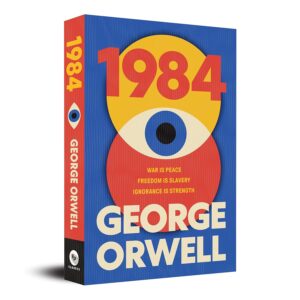
1984
by George Orwell
“A chilling dystopian masterpiece that exposes the terrifying consequences of totalitarianism, perpetual surveillance, and the systematic manipulation of truth, memory, and language.”
Table of Contents
ToggleOverview
George Orwell’s seminal novel, “1984”, published in 1949, stands as a monumental work of dystopian fiction and a profound cautionary tale against the perils of totalitarianism.
Set in a grim, perpetually war-torn future London, the capital of Airstrip One, a province of the superstate Oceania, the narrative plunges the reader into a world utterly dominated by the omnipresent Party and its enigmatic leader, Big Brother.
Orwell, a democratic socialist and staunch critic of both fascism and Stalinism, crafted this novel as a stark warning, drawing heavily on the political realities and ideological struggles of the mid-20th century, particularly the rise of Soviet communism and Nazi Germany.
The novel meticulously constructs a society where every aspect of life, from thought to emotion, is controlled and monitored. The Party maintains its absolute power through a sophisticated apparatus of surveillance (telescreens in every home and public space), psychological manipulation (doublethink, Newspeak), and brutal enforcement by the Thought Police. History is constantly rewritten by the Ministry of Truth, love is a political act, and individuality is a crime. The very concept of objective reality is under assault, replaced by whatever the Party declares to be true at any given moment.
At the heart of this oppressive world is Winston Smith, a low-ranking member of the Outer Party, whose job at the Ministry of Truth involves altering historical records to align with the Party’s current narrative. Winston, however, harbours a dangerous secret: a nascent, deeply personal rebellion against the Party’s lies and its eradication of human freedom. His yearning for truth, memory, and genuine human connection drives him to seek out forbidden knowledge and to question the Party’s absolute authority, setting him on a perilous path towards inevitable confrontation.
“1984” is not merely a political allegory; it is a psychological thriller that delves into the human spirit’s capacity for resistance and its ultimate vulnerability under extreme duress. It explores fundamental questions about the nature of power, truth, identity, and the very definition of humanity. Its enduring relevance lies in its prescient exploration of themes that continue to resonate in contemporary society, from government surveillance and propaganda to the erosion of objective truth and the dangers of unchecked authority, cementing its status as one of the most important literary works of the 20th century.
Key Takeaways
The Dangers of Totalitarianism and Surveillance
Orwell’s “1984” serves as the quintessential warning against totalitarian regimes that seek absolute control over every aspect of human life.
The Party’s omnipresent surveillance, epitomised by the telescreens and the Thought Police, eradicates privacy and fosters a climate of perpetual fear and suspicion. This constant monitoring ensures conformity, stifles dissent, and prevents the formation of any independent thought or collective resistance.
The novel meticulously illustrates how such a system can utterly dehumanise individuals, reducing them to mere cogs in the state’s machinery, devoid of personal autonomy or genuine connection.
Psychological Manipulation and Doublethink
One of the most chilling aspects of the Party’s control is its mastery of psychological manipulation. ‘Doublethink’ is the ability to simultaneously accept two contradictory beliefs as true, a cognitive dissonance enforced by the Party to maintain its narrative.
This concept, alongside the constant rewriting of history and the pervasive propaganda, demonstrates how a totalitarian power can control not just actions, but thoughts and perceptions.
By undermining objective reality and forcing individuals to internalise contradictory truths, the Party ensures that its version of reality is the only one that exists, making genuine rebellion or even coherent dissent impossible.
The Power of Language (Newspeak)
Orwell, a master of language himself, highlights its critical role in shaping thought through the invention of ‘Newspeak’. This controlled language is designed to diminish the range of thought by systematically eliminating words and concepts deemed undesirable by the Party.
The ultimate goal of Newspeak is to make ‘thoughtcrime’ literally impossible, as there would be no words to express rebellious ideas. This demonstrates Orwell’s profound understanding that controlling language is a powerful tool for controlling consciousness, limiting the capacity for critical thinking and ensuring ideological conformity by restricting the very tools of expression.
The Fragility of Truth and Memory
The Ministry of Truth, ironically, is responsible for falsifying history, constantly altering records to align with the Party’s current political agenda. This systematic revisionism means that objective truth and verifiable memory cease to exist.
Winston’s struggle to recall a genuine past, to find evidence of a time before the Party, underscores the terrifying ease with which a totalitarian regime can erase history and manipulate collective memory. When truth is fluid and dictated by power, individuals lose their sense of identity, their connection to the past, and their ability to challenge the present, leaving them utterly at the mercy of the ruling authority.
The Importance of Individual Freedom and Resistance
Despite Winston Smith’s ultimate failure, his initial acts of rebellion – keeping a diary, seeking truth, and engaging in a forbidden love affair – underscore the inherent human desire for freedom, autonomy, and genuine connection.
His struggle, however futile, serves as a powerful reminder of the value of individual thought, the courage required to question authority, and the profound importance of resisting oppressive systems. The novel, therefore, is not just a depiction of despair but a clarion call to safeguard intellectual freedom and to remain vigilant against any forces that seek to control thought and erase individuality.
Chapter Breakdown
Part 1: The Disillusionment of Winston Smith
Part 1 introduces Winston Smith, a thirty-nine-year-old Outer Party member living in a dilapidated London, a city perpetually shrouded in grime and decay. His daily life is a monotonous cycle of work at the Ministry of Truth, where he meticulously alters historical documents, photographs, and newspaper articles to conform to the Party’s ever-changing narrative. This act of historical revisionism, known as ‘rectification’, highlights the Party’s absolute control over truth and memory, making objective reality an impossibility.
Winston’s internal rebellion begins subtly with the purchase of a diary, a forbidden act of self-expression. In its pages, he dares to write “DOWN WITH BIG BROTHER,” an act of ‘thoughtcrime’ punishable by death. He reflects on the Party’s slogans – “WAR IS PEACE,” “FREEDOM IS SLAVERY,” “IGNORANCE IS STRENGTH” – and grapples with the concept of ‘doublethink’, the ability to hold two contradictory beliefs simultaneously and accept both. His longing for a past he can’t verify, for genuine human connection, and for a world free from the Party’s lies fuels his growing disillusionment.
He observes the ‘proles’, the uneducated masses who make up 85% of Oceania’s population, believing them to be the only hope for revolution due to their relative freedom from Party surveillance. He also becomes aware of two figures who will profoundly impact his life: Julia, a young woman from the Fiction Department whom he initially suspects of being a member of the Thought Police, and O’Brien, an Inner Party member whom Winston believes shares his rebellious sentiments and is part of a secret resistance movement against the Party.
Key Points
- Winston Smith’s introduction as a disillusioned Outer Party member working at the Ministry of Truth, where he rewrites history.
- His initial acts of rebellion: purchasing a diary and committing ‘thoughtcrime’ by writing “DOWN WITH BIG BROTHER.”
- The establishment of key Party concepts like ‘doublethink’, ‘Newspeak’, and the omnipresent surveillance of telescreens and the Thought Police.
- Winston’s observations of the ‘proles’ and his nascent hope that they might be the key to overthrowing the Party.
- His first encounters and suspicions regarding Julia and his intriguing, hopeful connection to O’Brien.
Part 2: The Illusion of Rebellion
Part 2 sees Winston’s rebellion escalate from internal thought to overt action. Julia, whom Winston initially feared, secretly passes him a note confessing her love. Their subsequent affair becomes a central act of defiance, as sexual relationships are strictly controlled by the Party, primarily for procreation, and any expression of personal love is considered ‘sexcrime’. Their clandestine meetings in the countryside and a rented room above an antique shop provide them with fleeting moments of intimacy and a fragile sense of freedom, an oasis from the Party’s pervasive gaze.
Julia’s rebellion is primarily personal and sensual; she despises the Party for restricting pleasure but lacks Winston’s ideological drive to overthrow it. Winston, however, sees their affair as a political act, a blow against the Party’s control over human emotion. Their shared secret deepens their bond, and they begin to believe they are part of a larger, hidden resistance. This belief is seemingly confirmed when O’Brien, the Inner Party member Winston had long suspected of being an ally, makes contact, inviting them to join the mythical Brotherhood, an underground organisation dedicated to overthrowing Big Brother.
O’Brien gives Winston a copy of ‘The Theory and Practice of Oligarchical Collectivism’ by Emmanuel Goldstein, the Party’s arch-enemy. This book, which Winston reads to Julia, articulates the true nature of the Party’s power, its perpetual war, and the mechanisms of its control. It provides Winston with intellectual validation for his rebellion, solidifying his belief in a shared cause. However, their brief period of hope and perceived safety is brutally shattered when the Thought Police raid their rented room, revealing that Mr. Charrington, the seemingly benign shop owner, is a member of the Thought Police, and O’Brien’s invitation was a sophisticated trap. Winston and Julia are arrested, their illusion of rebellion irrevocably broken.
Key Points
- Winston’s affair with Julia, a forbidden act of personal and sexual rebellion against the Party’s control over relationships.
- The contrasting motivations for their rebellion: Julia’s is personal and sensual, while Winston’s is ideological and driven by a desire for truth.
- O’Brien’s calculated manipulation of Winston, posing as a member of the Brotherhood to lure him into a trap.
- Winston’s reading of Goldstein’s book, which provides a detailed exposition of the Party’s totalitarian ideology and methods of control.
- The devastating betrayal and arrest of Winston and Julia, revealing the pervasive reach of the Thought Police and the futility of their rebellion.
Part 3: The Triumph of the Party
Part 3 plunges Winston into the Ministry of Love, the Party’s terrifying centre for re-education and torture. Here, he endures systematic physical and psychological torment designed to break his spirit and force him to love Big Brother. O’Brien, revealed as a high-ranking Party loyalist and his chief interrogator, meticulously dismantles Winston’s mind, explaining the Party’s true philosophy: power for power’s sake, not for the good of humanity, but for the sheer joy of exercising it. O’Brien asserts that the Party controls reality, memory, and even the laws of nature, demonstrating its absolute dominion over the individual.
Winston is subjected to increasingly brutal interrogations, starved, beaten, and deprived of sleep, forced to confess to fabricated crimes. His physical and mental resistance gradually crumbles, yet he clings to one last bastion of defiance: his love for Julia. He believes that as long as he can maintain this inner sanctuary, the Party cannot truly defeat him. O’Brien, however, understands this final point of resistance and reserves the ultimate betrayal for Room 101.
Room 101 contains each prisoner’s worst fear. For Winston, it is rats. Faced with a cage of starving rats about to be unleashed upon his face, Winston’s last shred of humanity breaks. In a desperate act of self-preservation, he screams for them to do it to Julia instead, betraying the one person he truly loved. This act signifies his complete psychological surrender. Later, released and physically recovered, Winston encounters Julia, but their bond is irrevocably severed; they both admit to betraying each other. The novel concludes with Winston sitting in the Chestnut Tree Café, a broken man, having fully internalised the Party’s ideology. He watches a news report celebrating a victory against Eurasia, and in a moment of profound, chilling clarity, realises he loves Big Brother, his individuality and capacity for independent thought utterly annihilated.
Key Points
- Winston’s imprisonment and torture in the Ministry of Love, where O’Brien systematically breaks him down physically and psychologically.
- O’Brien’s revelation of the Party’s true, terrifying philosophy: power is sought and maintained for its own sake, not for any ideological end.
- The Party’s absolute control over reality, memory, and the individual mind, as demonstrated by O’Brien’s re-education process.
- The ultimate betrayal in Room 101, where Winston is forced to confront his deepest fear (rats) and, in doing so, betrays Julia.
- Winston’s complete psychological surrender and conversion, culminating in his final, chilling acceptance and love for Big Brother.
Conclusion
George Orwell’s “1984” remains an unparalleled literary achievement, a chillingly prescient and profoundly influential work that continues to resonate with urgent relevance in the 21st century. Its enduring power lies not only in its vivid depiction of a dystopian future but also in its incisive analysis of the mechanisms of totalitarian power, psychological manipulation, and the systematic erosion of truth and individuality. The novel’s warnings about unchecked government surveillance, the weaponisation of information, and the dangers of ideological extremism have permeated global consciousness, giving rise to terms like ‘Orwellian’ to describe oppressive or manipulative systems.
Critically, “1984” is lauded for its masterful prose, its intricate world-building, and its unflinching exploration of the human condition under extreme duress. Orwell’s ability to craft a narrative that is both intellectually rigorous and emotionally devastating ensures its place as a cornerstone of modern literature. It forces readers to confront uncomfortable truths about power, freedom, and the fragility of objective reality, challenging them to consider the societal implications of technological advancement and political apathy.
Ultimately, “1984” is more than just a story; it is a vital philosophical treatise and a timeless cautionary tale. It serves as a stark reminder that the fight for truth, freedom, and individual autonomy is a perpetual one, demanding constant vigilance and courageous resistance against any force that seeks to control thought and rewrite reality. Its final, devastating image of Winston Smith’s complete submission to Big Brother leaves an indelible mark, cementing the novel’s status as a powerful and essential work that continues to provoke thought and inspire debate across generations.